
What Is Your Life Path Number? The Real History, Meaning, and Math Behind It
Type your birth date into a calculator, hit submit, and a single digit appears next to a paragraph describing your personality, your struggles, and your purpose. It feels oddly specific for three numbers added together — and that specificity is exactly why “life path number” gets searched hundreds of thousands of times a month worldwide.
Most articles about it open the same way: an ancient secret, traced back thousands of years to Pythagoras, finally revealed. It’s a good story. It’s also not quite true. The Life Path Number, as it’s calculated and interpreted today, is barely more than a century old — and knowing its real origin changes how you might read your own number.
This isn’t a how-to on calculating your Life Path Number — you’ll find that walkthrough on our Life Path Number Calculator page. This piece goes further: where the system actually came from, a calculation mistake that quietly changes people’s results, what the research says about whether any of this holds up, which numbers are genuinely rare versus common, and the Life Path Numbers of a few well-known public figures.
The Real History Behind “Ancient” Numerology
Pythagoras did believe numbers held deep meaning — he’s well documented exploring number mysticism and the mathematics of musical harmony in the 6th century BCE. Number symbolism of some form also shows up independently in Chaldean Babylon, Vedic India, and ancient China, long before Pythagoras was born.
What Pythagoras did not do is invent the Life Path Number, the birth-date reduction method, or the concept of master numbers. That system was built more than 2,000 years later, in early 20th-century New Jersey.
In 1908, a writer named Mrs. L. Dow Balliett published the first system mapping letters and birth dates to numbers, including the distinction between a birth number and a name number, and the rule that 11 and 22 should be treated as master numbers rather than reduced further. A few years later, her friend and fellow writer Dr. Julia Seton, a physician, coined the actual word “numerology” around 1912 — before that, the practice was usually called the “Science of Numbers.” Seton’s daughter, Dr. Juno Jordan, later formalized the Life Path, Challenges, and Cycles framework still used by numerologists today.
In other words: the Pythagorean name survives, but the system is a 20th-century American invention layered on top of it — not a direct 2,500-year-old lineage.
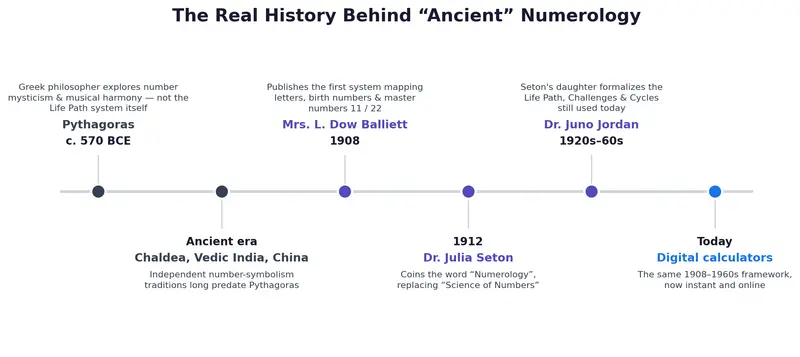
The Western Life Path system — often marketed as ancient — was actually built in the early-to-mid 1900sThis matters for a practical reason, not just a historical footnote. A system framed as “ancient wisdom” invites you to treat it as fixed and authoritative. A system that’s a hundred-some years old, assembled by a handful of specific people, invites a more useful question: what’s this actually good for, and what should you take with a grain of salt?
Numerology Around the World
This article uses the Western (Pythagorean) system throughout, since it’s the most widely practiced globally and the one behind our calculator. But it’s not the only tradition doing birth-date math — and one fact is worth knowing upfront: your Life Path Number itself doesn’t change between systems, since it’s pure arithmetic on your birth date, not your name. What differs between traditions is mostly how they calculate name-based numbers, and what additional layers they add on top.
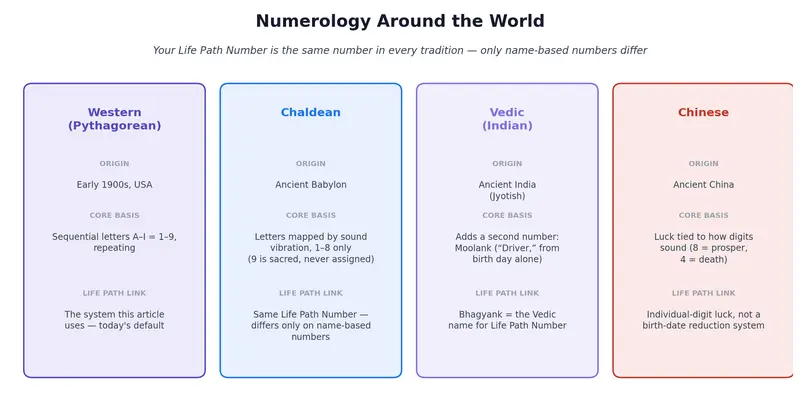
Chaldean numerology comes from ancient Babylon and is often described as the older of the two major Western-adjacent systems. It assigns numbers to letters based on sound vibration rather than alphabetical sequence, and treats 9 as too sacred to assign to any letter at all. The practical difference for you: Chaldean and Pythagorean produce the same Life Path Number, since that calculation only uses your birth date — they diverge on name-based numbers instead.
Vedic (Indian) numerology, rooted in Jyotish astrology, adds a second birth-date number most Western sites don’t mention: the Moolank (“Driver”), calculated from your birth day alone, reflecting your core personality. Your Bhagyank (“Conductor”) is calculated from your full birth date using the same reduction method as the Western Life Path Number — it’s the direct Vedic equivalent, sometimes additionally linked to one of the nine Navagraha planetary energies.
Chinese numerology works differently enough that it’s worth separating from the other two entirely. Rather than reducing a birth date to one governing number, it’s traditionally built around which individual digits are considered lucky or unlucky based on how they sound in Chinese — 8 (八) resembles the word for “prosper,” while 4 (四) resembles the word for “death.” Some modern sites apply the same day-month-year reduction formula and label the result a “Chinese Life Path Number,” but that’s a newer hybrid rather than the traditional practice.
A Calculation Mistake That Quietly Changes Your Result
Before getting into what the numbers mean, it’s worth flagging something most explainers skip: how you add the digits together can change your answer.
The standard method reduces your day, month, and year separately first, then adds those three results together. But it’s common — especially when people do the math by hand instead of using a calculator — to instead add every single digit of the full date together in one pass. Numerology reference sites specifically warn against this shortcut, noting that adding everything at once can either produce a master number that shouldn’t be there, or collapse one that should have survived the calculation.
The chart below walks through both methods side by side using the same birth date:
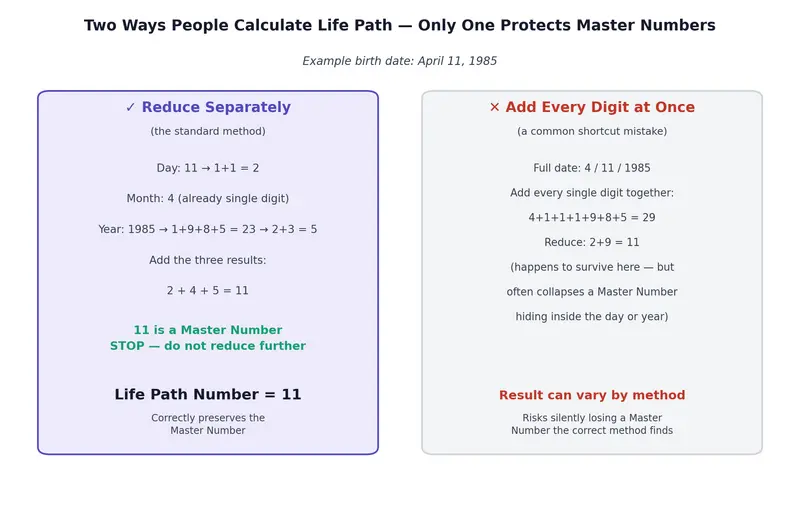
In this particular example, both methods happen to land on the same answer. But that’s not guaranteed — the risk is real enough that it’s the single most common source of “why did I get a different number on two different calculators” confusion. If your date involves an 11, 22, or 29 anywhere in the day, month, or year component, it’s worth double-checking your result on a dedicated calculator rather than doing the arithmetic by hand.
Is Any of This Backed by Research?
Worth asking directly, since it rarely gets a straight answer on numerology sites: no controlled or peer-reviewed research has validated that birth-date arithmetic predicts personality or life outcomes. That’s not a controversial claim among researchers — it’s simply outside what numerology, as a symbolic system, was ever designed to be tested against.
One well-documented reason numerology (and astrology, and generic personality quizzes) feels accurate is something psychologists call the Barnum effect — named for a 1949 study by psychologist Bertram Forer, who found that people rate vague, broadly applicable personality descriptions as highly accurate specifically for them. A description like “you sometimes doubt yourself but have deep inner strength” fits nearly everyone, but feels personal when it’s presented as being about you specifically.
That doesn’t necessarily make Life Path Numbers worthless — plenty of people use the framework the same way they’d use a Myers-Briggs type or an Enneagram number: as a structured prompt for self-reflection, not a scientific diagnosis. The distinction that matters is the same one that applies to any personality framework: useful for reflection, not evidence of anything predictive.
What Each Life Path Number Actually Means
Our calculator gives you a one-line trait summary for each number. Here’s a fuller picture — including the harder edges most numerology sites leave out.
Life Path 1 — The Originator. Independent, self-directed, and most comfortable leading rather than following. The common growth challenge: many 1s spend years feeling like they need permission to act, when the real work is trusting their own direction. Shadow side: can tip into stubbornness or difficulty accepting input from others. Example: a 1 who spends a decade waiting for a manager’s sign-off before pitching their own idea, then finally builds it independently — and wonders why they waited so long.
Life Path 2 — The Peacemaker. Diplomatic, intuitive, and genuinely skilled at reading a room. 2s often do their best work in partnership rather than solo. Shadow side: a tendency to over-accommodate others at their own expense, and difficulty with direct confrontation. Example: a 2 who mediates every disagreement in their friend group but rarely says what they actually want for themselves.
Life Path 3 — The Communicator. Expressive, creative, and socially magnetic — 3s tend to lift the energy of a room. Shadow side: scattered focus, and a habit of turning creative energy into anxious overthinking when it doesn’t have a productive outlet. Example: a 3 who can turn a slow dinner party into the highlight of everyone’s week, then lies awake replaying one small social misstep for hours.
Life Path 4 — The Builder. Practical, disciplined, and drawn to systems and structure. 4s are often the most reliable person in a group project. Shadow side: rigidity, and difficulty adapting when circumstances demand flexibility instead of a plan. Example: a 4 who plans their calendar a year in advance, then struggles most in the one week nothing goes according to plan.
Life Path 5 — The Adventurer. Adaptable, curious, and resistant to routine. 5s tend to change careers, cities, or interests more than most. Shadow side: restlessness that can undercut follow-through, and a harder time with long-term commitment. Example: a 5 who’s lived in four cities in six years and thrives on the change, but has never signed a lease longer than twelve months.
Life Path 6 — The Caregiver. Responsible, nurturing, and often the one family and friends lean on. Shadow side: over-responsibility for other people’s problems, sometimes at the cost of their own needs — a common burnout pattern among 6s specifically. Example: a 6 who organizes every family gathering and checks in on everyone, then quietly burns out because no one thought to check in on them.
Life Path 7 — The Analyst. Introspective, research-minded, and drawn to understanding why rather than accepting things at face value. Shadow side: a tendency toward isolation or overthinking, and discomfort with emotional vulnerability. Example: a 7 who researches a decision for weeks before acting, and finds small talk far more draining than an hour of deep conversation.
Life Path 8 — The Executive. Ambitious, goal-oriented, and comfortable with authority and material success. 8 is frequently cited as the “luckiest” number specifically for financial and career achievement. Shadow side: work can crowd out relationships and rest if left unchecked. Example: an 8 who built something from nothing through sheer discipline, and now has to consciously schedule time with people who aren’t clients.
Life Path 9 — The Humanitarian. Compassionate, big-picture thinkers with a pull toward causes larger than themselves. Numerologically, 9 represents completion and endings — the last single digit before the cycle restarts at 1. Shadow side: idealism that curdles into disappointment, and difficulty setting boundaries. Example: a 9 who volunteers for every cause that crosses their path, and struggles to say no even when their own plate is already full.
Life Path 11 — The Intuitive (Master Number). An amplified version of 2’s sensitivity, paired with heightened insight. Often associated with spiritual or creative callings. Shadow side: the intensity can manifest as anxiety or self-doubt if not channeled constructively. Example: an 11 who can sense a friend is upset before they’ve said a word, but struggles to explain where that certainty comes from.
Life Path 22 — The Master Builder (Master Number). An amplified version of 4’s practicality, paired with 11’s vision — considered the number most associated with large-scale, tangible achievement. Shadow side: the gap between big ambition and daily execution can feel overwhelming. Example: a 22 who can see an organization’s entire ten-year plan clearly, but gets stuck translating that vision into this week’s to-do list.
Life Path 33 — The Master Teacher (Master Number). The rarest Life Path Number by a wide margin, and considered an amplified version of 6’s caregiving instinct. Associated with selfless service and teaching. Shadow side: a near-total orientation toward others’ needs that can leave little room for the person’s own. Example: a 33 who ends up as the unofficial counselor in every group they’re part of, whether or not that role was ever asked for.
Which Life Path Number Is Actually the Rarest?
This is one of the most-searched questions about Life Path Numbers, and it has a genuinely data-backed answer — unlike most numerology claims.
An analysis of roughly 62 million U.S. birth records by PathNumbers.com, cross-referencing Social Security Administration and CDC birth data, found that Life Path 9 is the single most common number, followed closely by 8, 7, and 1 — each landing within a fraction of a percentage point of one another. On the other end, Life Path 33 is by far the rarest, appearing in roughly three-tenths of one percent of the population, with 22 and 11 also landing near the bottom.
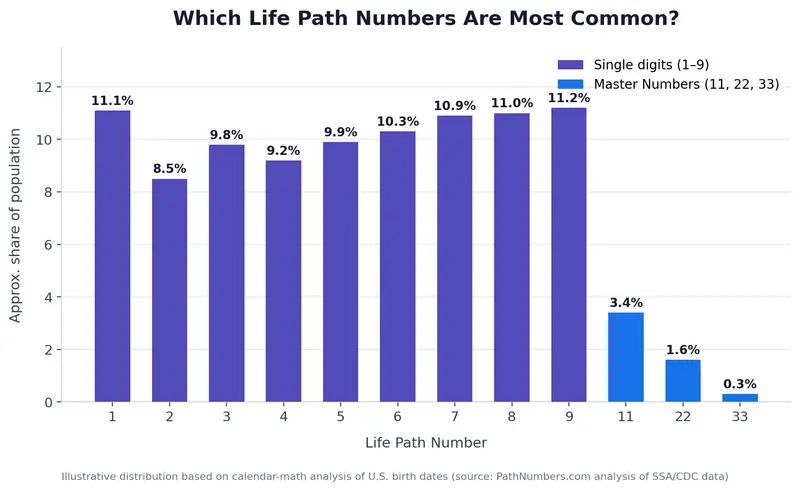
The reason has nothing to do with mysticism and everything to do with calendar math: any birth date whose digits sum to 9, 18, 27, 36, 45, or 54 reduces down to 9, and that’s a very wide net of possible dates. Master numbers, by contrast, require a much narrower, more specific combination of day, month, and year digits to land on 11, 22, or 33 without collapsing into a single digit — which is exactly why they’re statistically uncommon, independent of whatever spiritual significance is attached to that rarity.
Which Life Path Number Is the “Luckiest” or “Strongest”?
Two of the most common searches around this topic don’t have one settled answer, because “luckiest” and “strongest” mean different things depending on which numerologist you ask.
If the question is specifically about material or financial luck, Life Path 8 gets that label more than any other number — its whole association is with ambition, authority, and tangible achievement. If the question is about spiritual intensity or perceived power, that label usually goes to the master numbers, especially 11 and 22, because of both their rarity and the heightened traits attached to them.
There isn’t a consensus “strongest” number across numerology traditions — it depends heavily on what’s being measured. Which is itself a useful reminder that these labels are interpretive claims, not measured facts.
Why Does Life Path Number 9 Keep Coming Up as “Bad”?
If you’ve searched “why is life path number 9 bad,” here’s the likely source of the confusion: 9 represents endings, closure, and the completion of a cycle in numerology — themes that read as negative out of context, even though the actual interpretation is closer to “release and culmination” than anything punitive. Combined with 9 being the most statistically common Life Path Number, it’s also simply the number most people are searching about, which pulls in more mixed and inconsistent takes than rarer numbers do.
Life Path Numbers of a Few Well-Known Public Figures
Celebrity Life Path Numbers are one of the most consistently searched angles on this topic. Using each person’s publicly known birth date and the standard reduction method, here’s how a handful break down:
| Public Figure | Birth Date | Life Path Number |
| Elon Musk | June 28, 1971 | 7 |
| Barack Obama | August 4, 1961 | 2 |
| Bill Gates | October 28, 1955 | 4 |
| Albert Einstein | March 14, 1879 | 6 |
| Donald Trump | June 14, 1946 | 4 |
A caveat worth stating plainly: these are simple arithmetic results from public birth dates, not claims about what shaped anyone’s actual career or personality. Treat celebrity Life Path lists — on this site or any other — as a curiosity, not evidence that the number caused anything.
Life Path Compatibility
A common follow-up question is how two Life Path Numbers interact in a relationship. Compatibility readings vary noticeably between numerology sources — there’s no single agreed-upon chart — but a few pairings come up consistently enough across multiple sources to be worth sharing as general patterns, not fixed rules. One convention worth knowing: for compatibility purposes specifically, master numbers are typically read at their reduced base value (11 as 2, 22 as 4, 33 as 6), since compatibility is considered a single-digit-level comparison.
| Life Path | Often Cited As Easy Pairings | Often Cited As Higher-Effort Pairings |
| 1 | 3, 5, 6 | 1, 4, 8 |
| 2 | 6, 8 | 5 |
| 3 | 5, 7, 9 | 3, 4 |
| 4 | 2, 6, 8 | 3, 5 |
| 5 | 1, 3, 7 | 2, 6 |
| 6 | 1, 2, 8, 9 | 3, 7 |
| 7 | 4, 5, 7 | 6, 8 |
| 8 | 2, 4, 6 | 5, 9 |
| 9 | 3, 6 | 1, 8 |
Read these directionally, not definitively: a “easy pairing” with poor communication can still struggle, and a “higher-effort” pairing between two self-aware people can work well. As with everything else in this piece, treat compatibility readings as a conversation starter about values and habits — not a verdict on any specific relationship.
Your Personal Year Number: The Cycle Layered on Top of Your Life Path
Your Life Path Number never changes. Your Personal Year Number does — it moves through a repeating 9-year cycle and shifts every year, layering shorter-term timing on top of your fixed Life Path. It’s calculated differently too: instead of your birth year, you add your birth month, your birth day, and the current calendar year, then reduce to a single digit.
For example, someone born on June 15 calculating their 2026 Personal Year would add 6 (June) + 1+5=6 (the 15th, reduced) + 2+0+2+6=10→1 (2026, reduced) = 13 → 1+3 = Personal Year 4 — a year the framework associates with structure and foundation-building, distinct from whatever their fixed Life Path Number represents.
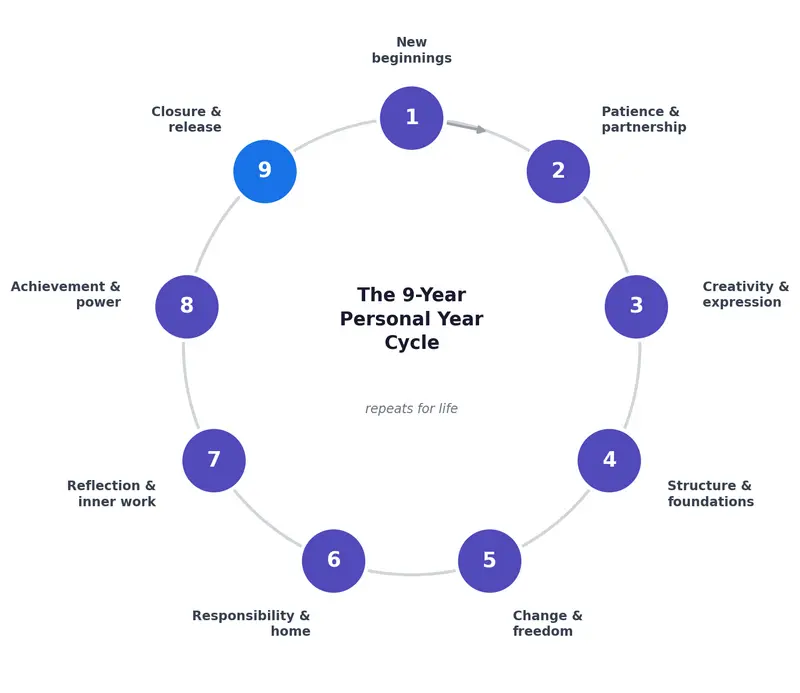
In numerology, the personal year number is calculated on a repeating 9-year cycleWhere your Life Path Number describes who you are at your core, your Personal Year Number is meant to describe what kind of energy surrounds the year you’re currently in — useful, some numerologists argue, for timing decisions like when to start a project versus when to consolidate. Curious what year you’re in? Use our free Personal Year Number Calculator to find out instantly.
The Bottom Line
The Life Path Number isn’t the ancient, unbroken Pythagorean tradition most sites present it as — it’s a specific, documented system built by three American writers in the early-to-mid 20th century. That doesn’t make it meaningless; frameworks for self-reflection don’t need to be scientifically validated to be personally useful, the same way journaling prompts or personality quizzes aren’t “proven” either. It does mean the number is worth holding a little more loosely than the “this reveals your true destiny” framing suggests — genuinely interesting as a lens for self-reflection, not a verdict on who you are or what you’re capable of.
Calculate Your Life Path Number
Curious what yours is? Use our free Life Path Number Calculator — enter your birth date and get your number, along with its meaning, instantly.
Frequently Asked Questions
What is the luckiest life path number?
There’s no single agreed-upon answer, but Life Path 8 is most often described as the luckiest specifically for financial and career success, since its core traits center on ambition, authority, and material achievement.
Which life path number is the rarest?
Life Path 33 is the rarest by a significant margin, found in roughly 0.3% of the population according to an analysis of U.S. birth records. Life Path 22 and 11 are also uncommon, since all three master numbers require a narrow combination of birth-date digits to avoid reducing down to a single digit.
What is the strongest life path number?
It depends on what “strongest” means to the person asking. For material achievement, 8 is usually cited. For spiritual intensity or heightened traits, the master numbers — especially 11 and 22 — tend to get that label instead. There’s no single number considered strongest across all numerology traditions.
Why is life path number 9 considered powerful — or sometimes “bad”?
Life Path 9 represents completion, closure, and the end of a numerological cycle, which some read as a negative theme out of context. It’s also the most statistically common Life Path Number, which means it shows up in more search results and interpretations overall — including inconsistent ones.
How do I find my life path number?
Add your birth day, month, and year separately, reducing each to a single digit (unless it’s already 11 or 22), then add those three results together and reduce once more — unless the final sum is 11, 22, or 33, in which case you stop there. Our Life Path Number Calculator does this instantly if you’d rather skip the manual math.
What is Elon Musk’s / Obama’s / Einstein’s life path number?
Based on their publicly known birth dates, Elon Musk’s Life Path Number works out to 7, Barack Obama’s to 2, Bill Gates’ to 4, Albert Einstein’s to 6, and Donald Trump’s to 4, using the standard calculation method.
Is numerology scientific?
No — there’s no direct research validating that birth-date arithmetic predicts personality or life outcomes. Numerology is a symbolic, interpretive framework, not an empirically tested one. Its appeal is often explained by the Barnum effect, where vague personality descriptions feel personally accurate to almost anyone reading them.
Can my life path number change?
No. Since it’s calculated entirely from your date of birth, your Life Path Number stays the same for your entire life.
Is Chaldean numerology more accurate than Pythagorean numerology?
Neither is more “accurate,” since neither is empirically validated — they’re different traditions with different origins. Chaldean is older and vibration-based, focusing heavily on name numbers; Pythagorean is the sequential system most Western sites, including this one, use by default. Your Life Path Number is identical in both, since it comes from your birth date rather than your name.
What’s the difference between Moolank and Bhagyank in Vedic numerology?
Moolank (the “Driver” number) comes from your birth day alone and reflects your core personality and instincts. Bhagyank (the “Conductor” number) comes from your full birth date, using the same reduction method as the Western Life Path Number — it’s the direct Vedic equivalent of that number.
What is a Personal Year Number?
It’s a separate numerology figure from your Life Path Number, calculated by adding your birth month, birth day, and the current calendar year, then reducing to a single digit. Unlike your Life Path Number, it changes every year, moving through a repeating 9-year cycle.
What’s the difference between a life path number and a destiny number?
Your Life Path Number comes from your date of birth and is considered the most important number in a numerology chart. Your Destiny Number (sometimes called an Expression Number) comes from the letters in your full birth name instead, and is meant to reflect your talents and life purpose from a different angle.
Related tools: Life Path Number Calculator, Angel Number Calculator, Personal Year Number Calculator, Soul Urge Number Calculator