
What Is BMI and Why It Doesn’t Tell the Full Story?

Type “what is BMI” into Google and you’ll get the same answer everywhere: a formula involving your weight and height that sorts you into underweight, normal, overweight, or obese. That part is simple and hasn’t changed since the 1970s.
What has changed is how seriously the medical establishment treats that number. In 2023, the American Medical Association — one of the largest physician groups in the world — adopted a formal policy telling doctors not to rely on BMI alone. Since then, obesity researchers, hospital systems, and registered dietitians worldwide have echoed the same message with increasing frequency: BMI is a screening tool, not a diagnosis.
This piece isn’t a how-to on calculating your BMI (you’ll find that on our BMI Calculator page). It’s about what BMI actually captures, where it breaks down, what current research says about who it fails, and what health professionals now recommend using alongside it — including a threshold that may already be affecting your own numbers, depending on your age, ethnicity, or activity level.
Quick Recap: What Is BMI and What It Measures
Now the question arises—what is BMI? Well, BMI = weight (kg) ÷ height (m)². It’s a ratio, not a direct measurement of fat, and it was developed in the 1830s by Adolphe Quetelet, a Belgian mathematician studying population averages — not individual health. It became a clinical tool decades later, in the 1970s, largely because it correlated reasonably well with body fat across large groups and was cheap and fast to calculate at scale.
That origin story is the root of most of its problems: a formula built to describe populations was never designed to make judgments about individuals. As one physician-authored patient resource put it plainly, BMI is a screening tool rather than a diagnosis, and it can be misleading precisely because it doesn’t account for body fat percentage, fat distribution, muscle mass, age, or ethnicity — with your true health risk better captured by measures like waist circumference, blood pressure, blood sugar, cholesterol, and cardiovascular fitness.
The 2023 Turning Point: What the AMA Actually Said
The American Medical Association’s 2023 policy notes that BMI cutoffs are based mainly on data from earlier generations of non-Hispanic white populations and don’t factor in a person’s sex or ethnicity. The policy recommends BMI be used together with other measures — visceral fat, body composition, relative fat mass, and waist circumference among them — rather than as a standalone risk indicator.
The AMA also pointed out that while BMI correlates reasonably well with fat mass across large populations, that correlation weakens significantly when applied to any one individual. In plain terms: BMI can tell you something useful about a country’s obesity trends. It’s much less reliable for telling you something about you.
Fatima Cody Stanford, an obesity medicine physician at Harvard Medical School, welcomed the shift, noting it reflects that BMI is a screening tool rather than a diagnostic one — a distinction that matters far more than most BMI charts let on.
This wasn’t a fringe opinion. It came from the same body that helps set clinical standards across American medicine, and hospital health systems have since published their own patient-facing guidance echoing it — one health system’s 2026 patient resource notes that healthcare professionals often use BMI as a starting point, not a diagnosis, describing it as just one of several measurements doctors consider when discussing treatment options like GLP-1 medications or bariatric surgery.
Separately, a 2024 clinical review published in Current Obesity Reports by researchers at the University of Alabama at Birmingham reached a similar conclusion: BMI is generally sufficient as a starting measure of obesity, but only when confirmed against an actual measure of fat distribution — such as waist circumference or waist-to-height ratio — and paired with a clinical evaluation of weight-related health complications. Diagnosis, in other words, needs more than one number.
The Cutoff Most Western Health Content Never Mentions
Here’s something that rarely comes up in Western health content: the standard BMI categories don’t apply the same way everywhere.
Research going back over two decades has shown that people of Asian descent tend to develop diabetes, high blood pressure, and cardiovascular disease at meaningfully lower BMI levels than the standard Western cutoffs suggest. For the same amount of body fat, age, and sex, Asian populations tend to run about 2–3 points lower in BMI compared to white populations, partly due to differences in body build and muscularity — meaning the same health risk shows up at a lower number on the scale.
In response, the WHO’s Western Pacific Regional Office convened an expert panel that recommended a separate BMI classification for Asian populations: normal weight from 18.5–22.9, overweight from 23–24.9, and obese at 25 and above — noticeably tighter than the global standard of 25 for overweight and 30 for obese.
Several countries have built this into national guidance:
- India uses 23 as the overweight threshold and 25 for obesity, based on the national Consensus Statement for Diagnosis of Obesity
- China classifies overweight from 24–27.9 and obesity from 28 upward under its national obesity working group guidelines
- Japan and South Korea use 23 and 25 as their overweight and obesity thresholds respectively
The visual below shows how differently the same BMI number can be classified depending on which standard is applied:
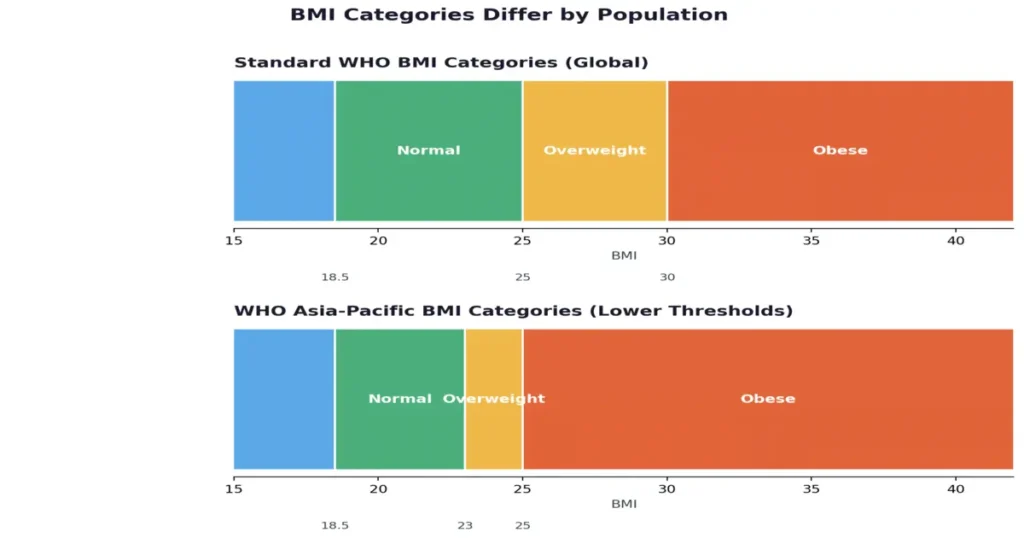
The practical implication can be completely different for a varied range of geographic area : someone with a BMI of 24 would be told they’re in the “normal” range under the global WHO standard, but “overweight” under the Asia-Pacific standard used in India, China, Japan, and South Korea. Same number, different verdict — because BMI’s default population baseline was built primarily from data collected on white European populations, and it doesn’t automatically generalize for the people around the globe.
This matters for a very practical reason: several studies have found that Asian individuals carry a higher percentage of body fat, and more of it is stored as visceral (abdominal) fat, than white individuals at the same BMI — which is precisely the kind of fat most strongly linked to metabolic disease. A “normal” BMI reading, by global standards, can still mask elevated risk in exactly this scenario.
Why Muscle Wrecks BMI’s Accuracy
This deserves more than a passing mention because it’s the single most common reason people get a confusing BMI result — and it’s a direct answer to one of the most frequently searched BMI questions: why is my BMI high when I’m not fat?
BMI has no way to distinguish tissue types — it only sees total mass relative to height. Muscle tissue is denser than fat tissue, meaning a given volume of muscle weighs more than the same volume of fat. Someone who trains seriously can carry noticeably more muscle mass than an average person at the same height, and BMI interprets that added weight identically to added fat.
The chart below illustrates this with two hypothetical people who share the exact same BMI of 27 (solidly in the “overweight” category) but have almost opposite body compositions:
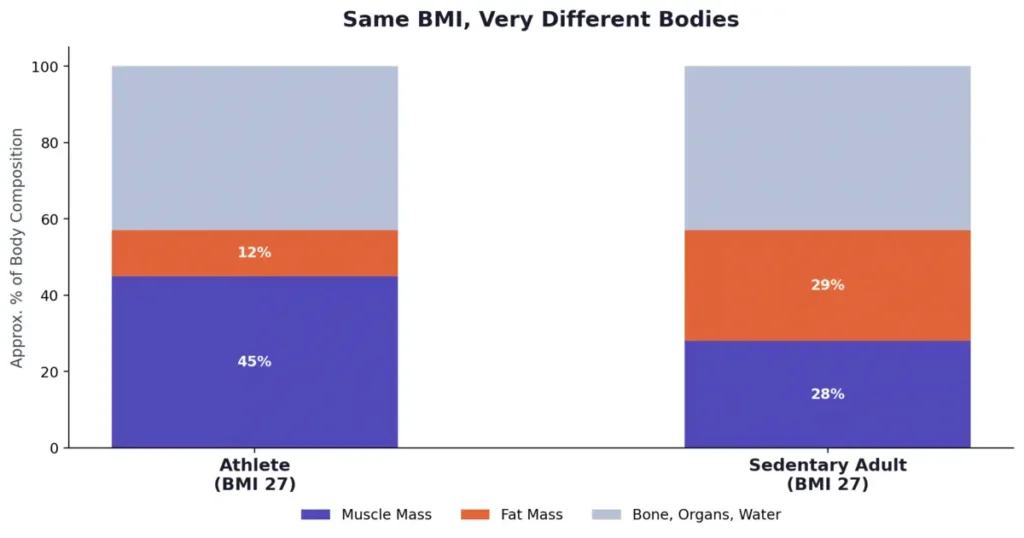
This is why it’s common to see:
- Competitive athletes and bodybuilders classified as “overweight” or “obese” by BMI despite very low body fat percentages
- Older adults with declining muscle mass (“sarcopenia”) land in the “normal” BMI range while carrying a higher percentage of body fat than their number suggests — sometimes described as being “skinny fat”
Both cases produce a BMI number that’s technically correct but practically misleading. It’s a structural limitation of the formula itself, not a flaw in how any individual calculator computes it — which is also why no BMI calculator, however well built, can fully solve this on its own.
What’s Replacing (or Supplementing) BMI
BMI’s limitations have pushed researchers to develop and test several alternative measures. None of them have fully replaced BMI yet, but they’re increasingly used alongside it, especially in specialist and research settings.
Waist-to-Height Ratio
This one has quietly become a favorite among researchers because of how simple it is to apply: keep your waist circumference under half your height. A waist-to-height ratio above 0.5 is associated with higher risk of central obesity and cardiometabolic problems, regardless of your BMI category. Unlike BMI, it directly captures abdominal fat — the type most strongly linked to heart disease and diabetes. A 2023 editorial on the topic specifically highlighted this ratio as the most consistent and practical alternative currently available for assessing central obesity and cardiometabolic risk, precisely because its threshold is so easy to communicate and remember.
Body Roundness Index (BRI)
Introduced in 2013 by mathematician Diana Thomas, BRI models the body as a vertical ellipse, using waist circumference and height instead of weight and height, to estimate visceral fat more directly than BMI does. To illustrate the concept: a powerlifter and a sedentary person of equal scale weight would score very differently on BRI — it correctly reflects the lifter’s muscle mass rather than flagging it as a risk, while still catching the sedentary person’s visceral fat. A large 2024 study published in JAMA Network Open found that both very low and very high BRI scores were associated with increased mortality risk, giving it a U-shaped risk curve rather than BMI’s simpler linear categories.
BRI isn’t perfect either — one commonly raised criticism, from registered dietitian Maya Feller, is that it favors leaner, less rounded body shapes, which may not fairly represent every healthy body type. But it’s a good example of how actively researchers are still trying to solve the problem BMI created.
Waist-to-Hip Ratio and A Body Shape Index (ABSI)
Both attempt to capture fat distribution rather than total mass. Waist-to-hip ratio compares waist size to hip size; ABSI factors in waist circumference relative to BMI and height. Evidence on whether either consistently outperforms simpler measures like waist-to-height ratio is mixed — a 2021 meta-analysis found ABSI performed notably worse than BRI, BMI, or waist circumference at predicting hypertension risk, while BRI performed roughly on par with BMI for that specific outcome. The overall pattern across this research is consistent even where the numbers vary: where fat sits on your body matters as much as how much of it there is.
None of these tools are things most people are likely to calculate on their own regularly, which is exactly why BMI — despite its flaws — remains the default. It’s fast, requires no special equipment, and is understood globally. The alternatives are often more accurate for specific clinical questions but less convenient for everyday screening.
The “Obesity Paradox”: Why BMI Gets Stranger With Age
One of the more counterintuitive findings in aging research is what scientists call the “obesity paradox” — a well-documented pattern in which mildly overweight or obese older adults sometimes show better survival outcomes and lower mortality than normal-weight older adults with the same conditions. This has been observed across a range of conditions, including heart failure, certain cancers, and general mortality risk in adults over 65.
Researchers caution this doesn’t mean gaining weight is protective. A more likely explanation is that BMI becomes an increasingly poor proxy for actual health in older age, since it can’t detect the muscle loss (sarcopenia) that often accompanies aging — meaning some “normal weight” older adults are actually undernourished or losing muscle mass, which carries its own serious health risks. Current research increasingly recommends that clinicians managing older adults focus on preserving muscle mass and function rather than chasing a specific BMI number, particularly since intentional weight loss in this age group often results in unwanted muscle loss alongside fat loss.
This is a good example of why doctors increasingly treat BMI as one input among several — its relationship with health risk isn’t fixed across your lifespan, and it shifts in ways a static chart can’t capture.
Where BMI Still Earns Its Place
None of this means BMI should be thrown out — including from your own health tracking. A 2024 review in the International Journal of Environmental Research and Public Health concluded that BMI remains valuable for population health surveys and primary healthcare screening, even though it has real limitations in predicting individual chronic disease risk. The recommendation from that review is that people who show as overweight by BMI should be more fully evaluated using combined anthropometric and performance measures — not that BMI should be ignored outright.
In other words: BMI is a reasonable first filter. The mistake is treating it as a final answer.
BMI and Weight-Loss Medication Eligibility
One increasingly common reason people search “what BMI qualifies for [medication]” is the rise of GLP-1 drugs like Ozempic (semaglutide) and Zepbound (tirzepatide). Clinical prescribing guidelines generally use a BMI of 30+ (obese) as a starting eligibility point, or 27+ when paired with a weight-related condition like type 2 diabetes or hypertension. Notably, even obesity medicine researchers have pushed back on using BMI alone for this decision too — a 2024 clinical review specifically noted that eligibility for bariatric surgery or GLP-1 medications should not be determined by BMI alone, and should instead involve a fuller clinical evaluation. These BMI figures are general benchmarks used in guidelines, not a substitute for an actual medical evaluation.
A Few Numbers Worth Knowing at a Glance
Since a lot of BMI searches are really just “is my number normal” questions in disguise, here’s a fast reference:
- A BMI of 20 sits comfortably within the normal range (18.5–24.9) under the global standard — not close to overweight
- A BMI of 25 is the exact line between “normal” and “overweight” globally, but is already “overweight” under Asia-Pacific standards
- A BMI of 27 is overweight under both standards, and is also the threshold at which some weight-loss medications become eligible if a related health condition is present
- A BMI of 30 marks the start of “obese” under the global standard, and sits well into that category under Asia-Pacific standards
None of these numbers say anything about your muscle mass, fat distribution, or overall health on their own — they’re just the boundaries of the categories themselves.
What Is a Healthy Weight, Beyond BMI?
Because of BMI’s limitations, a more complete picture of a “healthy weight” typically considers several additional measures alongside it:
- Waist circumference and waist-to-height ratio — flag abdominal fat, which carries elevated health risk independent of overall weight
- Body fat percentage — measures actual fat versus lean mass, typically via skinfold calipers, bioelectrical impedance scales, or a DEXA scan
- Blood pressure, cholesterol, and blood sugar — metabolic markers that BMI can’t capture at all
- Muscle mass and physical function — particularly important for older adults, where preserving strength matters as much as managing weight
- Overall fitness and activity level — a strong, active person and a sedentary person can share a BMI number while having very different health profiles
None of these individually replace BMI — they’re complements to it. The most reliable approach, echoed across the research cited throughout this piece, is to treat BMI as one data point among several, not a final verdict.
The Bottom Line
BMI isn’t obsolete, and it isn’t wrong to check it — it’s genuinely useful as a fast, free, first-pass screening number, and it remains a legitimate part of how doctors and dietitians start a conversation about weight and health. But 2023’s AMA policy shift, along with a growing body of research on ethnicity-specific risk, aging, and body composition, all point to the same conclusion: BMI is a starting question, not a final answer. Where you sit on a BMI chart is worth knowing. What you do with that number is a conversation better had with a doctor or registered dietitian, alongside measures like waist circumference or body composition, than with a chart alone.
Calculate Your BMI
Want your number first? Use our free BMI Calculator — it supports both metric and imperial units and shows your category instantly.
Some of the Frequently Asked Questions
Is a BMI of 20 or 25 “chubby”?
o. A BMI of 20 falls solidly within the normal range (18.5–24.9) under global standards, and a BMI of 25 sits right at the boundary between “normal” and “overweight” — already “overweight” under Asia-Pacific standards. Neither reflects being overweight by clinical standards, and BMI categories aren’t a measure of appearance; how a given BMI “looks” varies enormously based on height, frame, and muscle mass.
Is a BMI over 30 considered overweight?
A BMI of 30 or above falls into the “obese” category, not “overweight.” Overweight refers specifically to the 25.0–29.9 range under global standards. Obesity is further broken down into Class I (30–34.9), Class II (35–39.9), and Class III (40+).
Is 150 lbs overweight for someone at 5’4″?
At 5’4″ (64 inches), 150 lbs works out to a BMI of roughly 25.7 — just into the “overweight” category under global standards, and already “overweight” under Asia-Pacific standards. Whether that number reflects an actual health concern depends heavily on body composition, waist circumference, and overall fitness — not the BMI figure in isolation.
How much weight should I lose if my BMI is 27?
A BMI of 27 sits in the “overweight” range. Weight-loss targets are highly individual and depend on factors like body composition, health history, and goals — this isn’t something a BMI number alone can answer responsibly. If you’re using BMI as a starting point for a weight goal, it’s worth discussing your specific numbers with a doctor or registered dietitian rather than working from BMI in isolation.
Why don’t some doctors use BMI anymore?
They haven’t stopped entirely, but many now use it differently — as a first-pass screen rather than a standalone diagnostic tool, in line with the AMA’s 2023 guidance. The core reasons: it can’t distinguish muscle from fat, it ignores where fat is stored on the body, it doesn’t account for ethnicity-specific risk, and it says nothing about metabolic health markers like blood pressure or blood sugar.
What’s the best BMI calculator to use?
Any calculator using the standard formula (weight ÷ height²) will give you the same result — the formula itself is standardized, so accuracy doesn’t vary between reputable calculators. What matters more is choosing one that supports both metric and imperial units and clearly labels which category your result falls into.
Related tools: BMI Calculator, Ideal Weight Calculator, Calorie Calculator