
Simple Interest vs Compound Interest: Key Differences Explained

Interest is one of those words everyone assumes they already understand — until you look closer and realize Simple Interest Vs Compound Interest are actually two completely different formulas hiding behind the same term Borrow money, pay interest. Save money, earn interest. Simple enough, on the surface — except that single word is quietly hiding two completely different formulas, and which one applies to your loan or your savings account can end up mattering more than the interest rate itself.
Most people never think to ask which type they’re dealing with, mostly because nobody puts it in plain language. A credit card statement shows an APR. A car loan shows a monthly payment. A savings account shows an interest rate. None of them come out and say “this is simple interest” or “this is compound interest” in words you’d actually notice — even though that distinction is doing more work behind the scenes than almost any other number on the page.
Understanding Simple Interest Vs. Compound Interest
This piece isn’t a walkthrough of how to punch numbers into a calculator — you can do that on our Simple Interest Calculator in under a minute. It’s about what actually separates simple interest from compound interest, why compound interest has been called (a little dramatically, and almost certainly wrongly attributed) the eighth wonder of the world, where each type quietly shows up in the financial products you already use, and which one you should actually be rooting for, depending on which side of the transaction you’re standing on.
What Is Simple Interest?
Simple interest is interest calculated only on the original amount of money you borrowed or invested — what’s called the “principal.” However long the loan or investment runs, the interest for each period is based on that same fixed number. It never changes, and it never grows on itself.
The formula is straightforward:
I = P × R × T
- I is the interest earned or owed
- P is the principal, or starting amount
- R is the annual interest rate, written as a decimal (6% becomes 0.06)
- T is the length of time, in years
So for $10,000 at 6% over 20 years: I = 10,000 × 0.06 × 20 = $12,000 in interest. Add that to the original principal, and the total balance comes to $22,000 — the number from the example above.
What Is Compound Interest?
Compound interest is interest calculated on the principal and on any interest that’s already accumulated. Every time interest is calculated, it gets folded into the balance, and the next round of interest is calculated on that new, larger total. This is the mechanism people mean when they talk about interest “earning interest,” and it’s also why a savings account’s advertised rate is sometimes shown as an APY (annual percentage yield) rather than a flat interest rate — APY already factors in how often compounding happens.
The formula looks like this:
A = P(1 + r/n)^(nt)
- A is the final amount — principal plus all accumulated interest
- P is the principal
- r is the annual interest rate, as a decimal
- n is how many times per year the interest compounds (annually = 1, monthly = 12, daily = 365)
- t is the time, in years
Run the same numbers — $10,000 at 6%, compounded once a year, for 20 years — and the balance grows to $32,071.35. Same principal, same rate, same span of time. The formula is the only thing that changed.
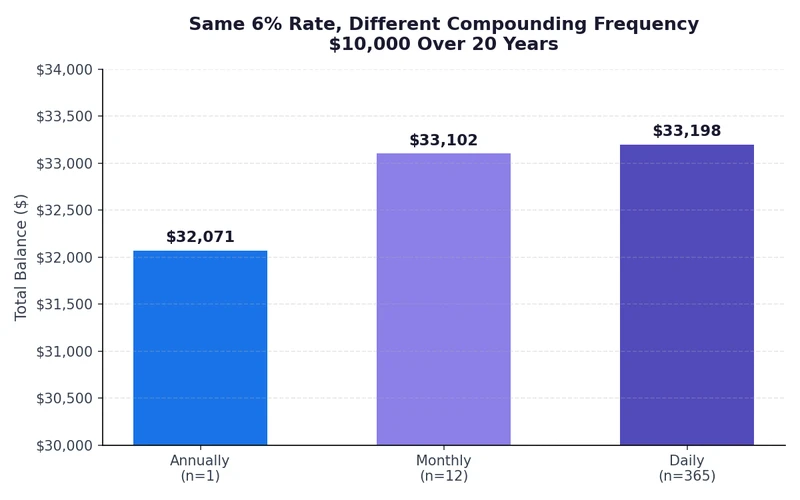
That n value in the formula — how often compounding happens — matters more than most people expect. Compounding annually, monthly, and daily at the same 6% rate on $10,000 for 20 years produces three slightly different totals: $32,071 compounded annually, $33,102 compounded monthly, and $33,198 compounded daily. The difference between monthly and daily is small, but the difference between annual and daily is over a thousand dollars, all from the same stated rate. This is part of why comparing two accounts by their advertised interest rate alone can be misleading — the compounding frequency is doing real work behind the scenes, which is exactly why banks are required to disclose APY rather than just a plain rate.
Compound interest itself isn’t a modern invention, even though it can feel like one. Mathematicians were building compound interest tables by hand centuries before calculators existed — the earliest known tables were published in France in the 1550s, and in 1613, an English scrivener named Richard Witt published Arithmeticall Questions, a book of compound interest tables detailed enough that historians still study it today as one of the founding texts of actuarial science. People have understood that money grows faster on itself for over 400 years; it’s the reasoning behind the formula, not the formula itself, that tends to trip people up.
You’ve probably also heard compound interest called “the eighth wonder of the world,” usually attributed to Albert Einstein. It’s a great line — and there’s no reliable record that Einstein ever said it. Historians and quote researchers have traced the phrase back only as far as financial sales literature from decades after his death, with no original source ever turning up. Whoever actually coined it, the underlying point holds up: compounding is one of the few places in personal finance where doing genuinely nothing — just waiting — measurably works in your favor.
The Core Difference: Interest on Interest
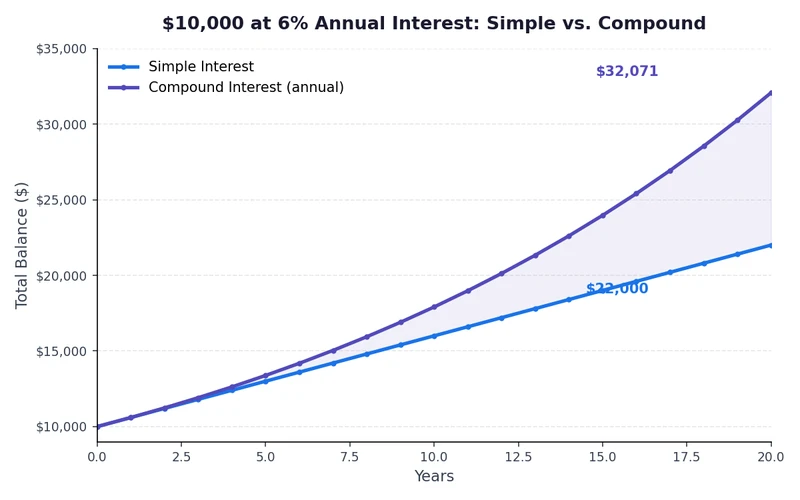
The gap between $22,000 and $32,071 doesn’t come from a higher rate or a bigger deposit — those are identical in both accounts. It comes entirely from what the interest is calculated on. Simple interest resets to the same base every single period: the original principal, forever. Compound interest keeps expanding the base it’s working from.
Look closely at year one in both accounts: they earn the exact same $600, because there’s only been one round of interest so far, and nothing has compounded yet. By year two, though, the compound account is earning interest on $10,600, not $10,000, so it edges very slightly ahead. That gap is barely visible for the first several years, which is a big part of why people underestimate compounding the first time they hear about it — and then it widens quickly in the back half of the timeline, because each year’s interest is now being calculated on a noticeably bigger number than the year before.
It behaves a lot like a snowball rolling downhill. Near the top of the hill, it’s small and picks up snow slowly — you’d barely notice it growing at all. But every extra layer of snow gives it more surface area to pick up even more snow on the next roll, and by the bottom of the hill it’s gaining size far faster than it started. Simple interest never picks up that extra surface area. It stays the same size the whole way down and adds snow at a fixed, predictable rate — which is exactly why it looks nearly identical to compound interest for the first few years, and then falls further and further behind.
The U.S. Securities and Exchange Commission’s investor education office, Investor.gov, points to this exact mechanic as the reason modest, regular savings can grow into meaningful sums given enough time — the earlier money starts compounding, the longer it has to work on itself, and the bigger the eventual payoff becomes relative to what was actually put in.
The Formulas Side by Side
It helps to see both formulas next to each other, since the simple interest vs compound interest comparison really comes down to what happens after this first step:
Simple interest: I = P × R × T
Compound interest: A = P(1 + r/n)^(nt)
Both start with the same principal (P) and the same annual rate (r or R). The difference is entirely in what happens after that. Simple interest multiplies the principal by the rate and by the number of years, once, and stops there. Compound interest raises (1 + r/n) to a power based on how many compounding periods have passed, which is what lets the interest build on itself instead of staying flat. The more frequently compounding happens — daily instead of annually, for instance — the faster that number grows, even at the exact same annual rate.
Worked Example: Same Principal, Same Rate, Different Math
Here’s the same $10,000 at 6%, tracked at four checkpoints, so you can see exactly where the two methods start to pull apart:
| Year | Simple Interest Balance | Compound Interest Balance |
| 1 | $10,600 | $10,600 |
| 5 | $13,000 | $13,382 |
| 10 | $16,000 | $17,908 |
| 20 | $22,000 | $32,071 |
Notice that year one is identical in both columns — the two methods can’t diverge yet, because there’s only been one period of interest, and compounding needs at least two periods to start showing its effect. By year five, the compound account has pulled about $382 ahead. By year ten, that gap has grown to roughly $1,908. And by year twenty, the compound account has earned $22,071 in total interest against the simple account’s $12,000 — nearly double, from the exact same starting point, rate, and time span.
Where Each Type Is Actually Used
You don’t usually get to choose between simple and compound interest on a case-by-case basis — the type of loan or account you’re using decides it for you. That’s actually good news in a way: once you know which category a product falls into, you already know roughly how the math behind it works, without needing to read the fine print of every disclosure.
Simple interest is the standard for:
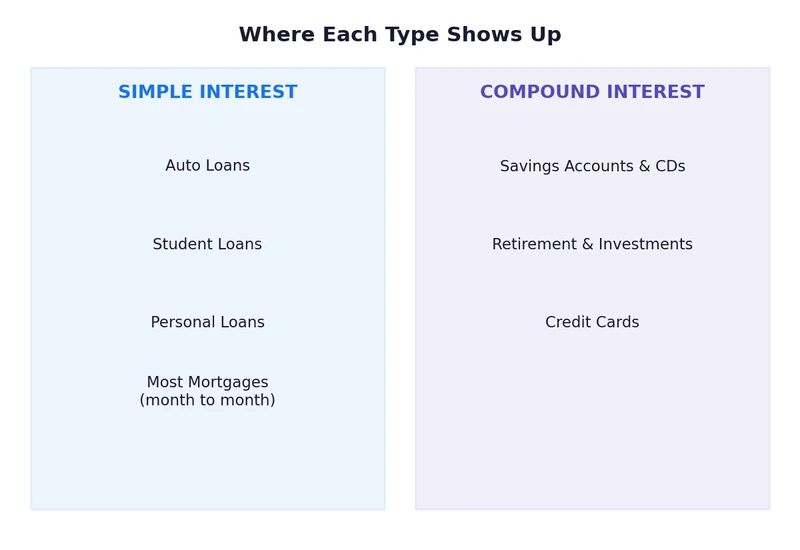
- Auto loans. Most car loans from banks and credit unions use simple interest, calculated on your outstanding balance.
- Student loans and personal loans. Interest accrues only on what you actually still owe, the same way it works on an auto loan.
- Many mortgages. Interest is typically recalculated each month on the remaining principal balance, which functions much like an auto loan’s math, just stretched across a far longer term.
Mortgages deserve a bit more explanation, because they can look compound at a glance and aren’t quite. A mortgage is amortized — each monthly payment is split between interest (calculated simply, on whatever principal remains that month) and principal reduction, following a schedule set at the start of the loan. Early payments lean heavily toward interest because the remaining balance is largest then; later payments lean toward principal because the balance has shrunk. The math behind each individual month is simple interest. It’s the amortization schedule stacking thirty years of those months together that makes total mortgage interest add up to such a large number.
Not every lender calculates simple interest the same way, though. The Consumer Financial Protection Bureau notes that a small number of lenders instead use “precomputed interest,” which behaves differently and generally isn’t in the borrower’s favor — but the CFPB describes that method as uncommon outside certain subprime lending situations. More on exactly how that catches people off guard in the “paying off early” section below.
Compound interest is the standard for:
- Savings accounts, CDs, and money market accounts. This is compounding working in your favor — the longer the money sits, the faster it grows.
- Retirement and investment accounts. Long-term compounding is essentially the entire point of investing early, which is why financial educators emphasize starting as soon as possible rather than waiting for a “better” time.
- Credit cards. This is compounding working against you. The CFPB explains that most card issuers apply a daily periodic rate, meaning any interest you don’t pay off gets added to your balance and starts accruing its own interest the very next day — which is exactly why a credit card balance can grow so much faster than the minimum payment suggests.
Which Is Better?
There’s no universal answer to the simple interest vs compound interest question — it depends entirely on which side of the transaction you’re on.
If you’re borrowing money, simple interest is almost always the friendlier structure, because your interest charge stays tied to a shrinking balance instead of compounding on top of unpaid interest. If you’re saving or investing money, compound interest is the one you want, because your balance accelerates instead of growing in a flat, straight line.
The confusion usually comes from treating “better” as an abstract, fixed property of the interest type itself, rather than asking the one question that actually settles it: am I the one paying the interest, or the one earning it? Whichever role you’re in tells you which type you should be hoping for.
A quick way to picture it: imagine two neighbors who each set aside $10,000 the same week. One puts it in a simple-interest bond at 6%. The other puts it in a compound-interest index fund also averaging 6%. Ten years in, the difference between them is a modest $1,908. By year twenty, it’s over $10,000. Neither neighbor did anything differently — they didn’t save more, take more risk, or check their balance more often. The entire gap is the product of one structural choice made on day one, which is exactly why picking the right account type matters as much as picking a good rate.
Disadvantages of Simple Interest
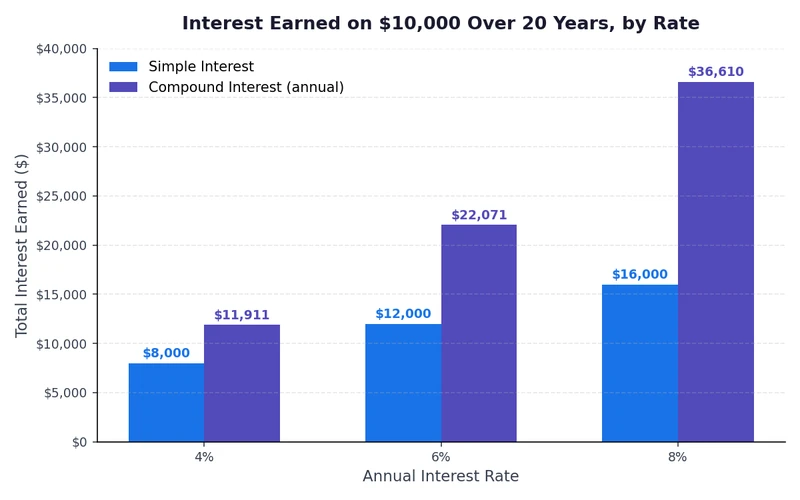
For borrowers, simple interest is close to a non-issue — its predictability is genuinely a feature, not a flaw. The real disadvantage only shows up on the saving and investing side of the equation. A simple-interest savings account or bond grows in a straight line no matter how long you leave the money there, while a compound-interest account keeps accelerating the longer it runs.
The chart above shows how much that gap widens depending on the rate. At 4%, compounding earns about 49% more interest than simple interest over 20 years. At 6%, it’s closer to 84% more. At 8%, the compound account earns well over double what the simple account earns — on the exact same $10,000, over the exact same 20 years. This is really the whole reason financial advisors steer people toward compounding vehicles for long-term goals like retirement, rather than accounts or bonds that only pay simple interest.
There’s a second, less obvious downside worth naming: because simple interest never accelerates, it also never rewards patience the way compound interest does. Leaving money in a simple-interest account for an extra five or ten years adds a predictable, linear amount each year — useful for planning, but it means there’s no real incentive to leave the money alone longer than you need to. A compound-interest account does the opposite: the incentive to leave it untouched grows every year, since each additional year of patience is worth more than the year before it.
Can You Pay Off a Simple-Interest Loan Early?
Yes — and in most cases, it genuinely saves you money. Because simple interest recalculates on your outstanding balance rather than locking in a fixed total upfront, every extra payment you make toward the principal shrinks the base your next interest charge gets calculated on. Pay down a simple-interest car loan faster than scheduled, and you pay less total interest over the life of the loan — not just less time spent paying.
That’s a meaningful distinction from the small number of “precomputed interest” loans mentioned earlier, where the total interest is calculated upfront and spread evenly across your payments. In that structure, paying early doesn’t save you the same way, because the interest total was already locked in before you made a single payment. The reassuring part, per the CFPB, is that precomputed interest is genuinely uncommon at mainstream banks and credit unions — most auto, student, and personal loans use simple interest by default.
The specific mechanism behind most precomputed loans is called the Rule of 78s — sometimes called the “sum of the digits” method, because it splits a loan’s total interest into fractions based on adding up the loan’s month numbers (1 through 12 for a one-year loan adds up to 78, hence the name). It deliberately front-loads more interest into the earliest payments, so someone who pays the loan off ahead of schedule ends up having already paid a disproportionate share of the total interest, with far less benefit from stopping early than a simple-interest borrower would get.
The good news is that this practice is largely regulated out of existence for anything long-term — federal law has prohibited the Rule of 78s on consumer loans longer than 61 months since 1993, and a number of states have banned it outright even on shorter loans. It still legally shows up occasionally on some short-term auto and personal loans, which is one more reason it’s worth reading the actual terms before signing, rather than assuming every loan works the same way underneath.
If you’re not certain which kind of loan you have, your original loan agreement will say so, and a quick call to your lender can confirm it.
The Bottom Line
The simple interest vs compound interest distinction isn’t a competing set of products you get to shop between — they’re two different formulas baked into whatever loan or account you’re already using, and the gap between them only becomes real money over time. On a one-year loan, the difference between the two methods is small enough to ignore. Stretch that same comparison across a car loan, a mortgage, or a retirement account held for decades, and it stops being a rounding error and starts being the single biggest factor in what you actually pay or actually keep.
The practical takeaway isn’t to chase one type over the other in the abstract — it’s to notice which one applies to whatever you’re looking at right now, and to remember that the effect compounds (quite literally) with time. A savings account opened five years earlier, or a loan paid down five years faster, isn’t a small head start. Given how these formulas behave, it’s often the entire difference in outcome.
Fast Reference Cheat Sheet
- Simple interest: I = P × R × T — always calculated on the original principal, no matter how much time passes
- Compound interest: A = P(1 + r/n)^(nt) — calculated on the principal plus everything it’s already earned
- If you’re borrowing, simple interest is usually the cheaper structure
- If you’re saving or investing, compound interest is usually the better outcome
- $10,000 at 6% for 20 years: $22,000 total (simple) vs. $32,071 total (compound) — a gap of over $10,000 from the same starting point
- The gap between the two starts small and widens the longer the money sits — time matters at least as much as the rate itself
Calculate Yours
Want the exact numbers for your own principal, rate, and timeframe, instead of the round numbers used throughout this piece? Use our free Simple Interest Calculator — enter any three of the four values (principal, rate, time, or interest amount) and it solves for the fourth instantly.
Frequently Asked Questions
Which is better, simple interest or compound interest?
Neither is universally “better” — it depends on which side of the transaction you’re on. Simple interest is friendlier if you’re borrowing, since it doesn’t compound on unpaid interest. Compound interest is friendlier if you’re saving or investing, since your balance grows faster over time.
What is the difference between simple interest and compound interest?
Simple interest is calculated only on the original principal for the entire term. Compound interest is calculated on the principal plus any interest that has already accumulated, so the base it’s calculated on keeps growing.
What are the disadvantages of simple interest?
For borrowers, there isn’t much of one — it’s usually the cheaper option. For savers and investors, the disadvantage is that a simple-interest account grows in a straight line no matter how long you hold it, missing out on the accelerating growth that compounding provides.
Can you pay off a simple interest loan early?
Yes. Because the interest is recalculated on your remaining balance, paying extra toward the principal reduces the amount future interest is calculated on, which lowers your total interest cost over the life of the loan.
Are car loans simple or compound interest?
Most car loans from banks and credit unions use simple interest, calculated on your outstanding balance. A small number of lenders use “precomputed interest” instead, which behaves differently — it’s worth checking your loan agreement if you’re planning to pay ahead of schedule.
Is simple interest ever better than compound interest?
For a borrower, yes — simple interest is usually the more affordable structure, since your balance doesn’t compound against you. For a saver or investor, compound interest is almost always the better outcome over time.
What’s the formula for simple interest vs compound interest?
Simple interest: I = P × R × T. Compound interest: A = P(1 + r/n)^(nt), where n is how many times per year the interest compounds. Both use the same principal and rate — the difference is entirely in how often interest gets folded back into the balance.
Why does compound interest earn more than simple interest?
In a Simple Interest Vs. Compound Interest comparison, compound interest can earn more because each period’s interest is added to the balance and can then earn additional interest. With simple interest, interest continues to be calculated only on the original principal.
Is simple interest or compound interest better for a savings account?
When comparing Simple Interest Vs. Compound Interest for savings, compound interest is generally more beneficial because your accumulated interest can also earn interest. The longer you leave the money invested, the more noticeable this compounding effect can become.
Does Simple Interest Vs. Compound Interest matter for loans?
Yes. Simple Interest Vs. Compound Interest can make a significant difference in how much interest you pay over time. With simple interest, interest is generally based on the outstanding principal, while compound interest can cause previously accumulated interest to become part of the amount on which future interest is calculated.
Related tools: Simple Interest Calculator, Loan EMI Calculator, Retirement Calculator