
What Is BMR and How Many Calories Do You Really Burn at Rest?

What is BMR? Basal Metabolic Rate (BMR) is the minimum number of calories your body burns at complete rest to keep your heart beating, lungs breathing, brain functioning, and cells alive. Understanding what is BMR is essential if you’re trying to lose weight, gain muscle, or simply estimate your daily calorie needs. Despite how often it’s discussed online, what is BMR is still widely misunderstood—and that’s where the confusion begins.
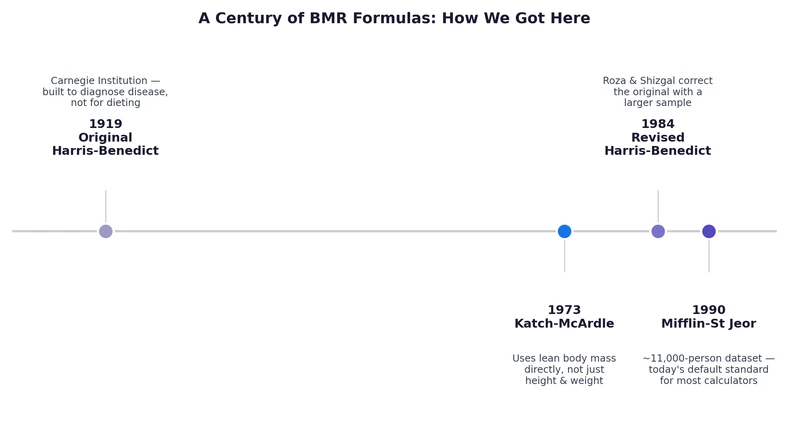
In 1919, two researchers at the Carnegie Institution published a metabolism study with no interest in weight loss whatsoever. James Arthur Harris and Francis Gano Benedict were trying to give doctors a reliable way to catch diabetes, thyroid disease, and other metabolic disorders earlier — and to do that, they first had to establish what a healthy resting metabolism looked like. That baseline number is the same one sitting on every calorie calculator online today. Somewhere between then and now, it picked up a job it was never built for: telling people how little to eat.
That’s the root of most BMR confusion. A BMR of 1,400 calories does not mean eating 1,400 calories a day — it’s a resting-energy floor, not an eating target — but that mix-up drives more search traffic than the actual definition of BMR does. Questions like “should I eat exactly my BMR to lose weight faster?”, “my BMR is 1,400, now what?”, or “can spicy food actually raise my metabolism?” carry far more real-world weight than the textbook definition, and most BMR content skips past them entirely.
This piece isn’t a how-to on calculating your own BMR — the formulas and a working calculator are already on our BMR Calculator page. What follows instead is a deeper look at where this number came from, what a century of metabolic research actually says about raising or lowering it, why eating below it backfires, and the handful of quiet factors — genetics, thyroid health, pregnancy, plain old age — that can shift it more than people expect.
Quick Recap: What BMR Actually Measures
Basal Metabolic Rate is the energy your body burns at complete rest — no movement, no digestion, nothing beyond keeping your organs running: breathing, circulation, cell repair, temperature regulation. For most people it’s the single largest slice of total daily calorie burn, typically somewhere in the range of 60–75% of it, before activity or digestion are added on top.
A Worked Example
Numbers make this easier to picture than definitions do. Take a 32-year-old woman, 65kg, 165cm tall. Using the Mifflin-St Jeor equation — the formula most modern calculators default to — her BMR comes out to roughly 1,383 kcal/day. That’s the energy her body needs before she takes a single step, checks her phone, or eats a meal. If she’s moderately active, multiplying that by a typical activity factor of around 1.55 puts her total daily need (her TDEE) closer to 2,140 kcal — nearly 800 kcal higher than BMR alone.
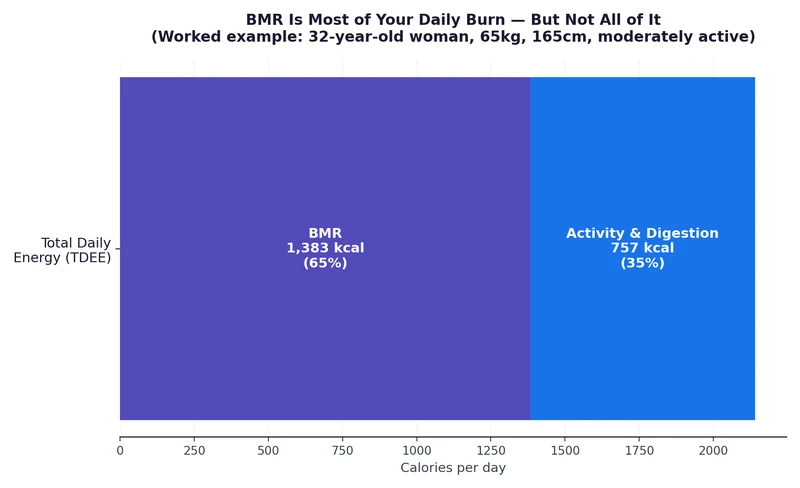
That gap between BMR and TDEE is the part most confusion about BMR actually comes from, and it’s worth holding onto as you read the rest of this piece. For the exact formulas and a calculator to run your own numbers, see the BMR Calculator tool. What’s more useful to understand here is where this number came from in the first place, because the history explains a lot about how it gets misused today.
The 1919 Origin Story Nobody Mentions
Who Harris and Benedict Actually Were
Most calculators cite the year 1919 and move on. The fuller story explains something that matters: BMR wasn’t built as a dieting tool. It was built to diagnose disease.
Between roughly 1909 and 1917, physiologists James Arthur Harris and Francis Gano Benedict ran a series of metabolic studies out of the Carnegie Institution of Washington’s Nutrition Laboratory, publishing the results in 1919 under the title “A Biometric Study of Basal Metabolism in Man.” Their goal was to establish a dependable baseline for healthy metabolism — something doctors could measure a patient against when something looked physiologically off.
The specific conditions they were comparing that baseline against were diabetes, thyroid disease, and febrile illness — a detail worth remembering, because thyroid function is still one of the biggest reasons a real person’s BMR can drift sharply from what a calculator predicts, as later sections in this piece get into.
From Wartime Nutrition Science to Your Phone’s Calculator
The original 1919 equations stayed the clinical standard for over sixty years. In 1984, researchers Roza and Shizgal revised the formula using a larger, more representative sample. Then in 1990, Mifflin and St Jeor published a new equation built from a much bigger, more contemporary dataset of roughly 11,000 people — now generally treated as the most broadly accurate for typical adults, and the default formula on most modern calculators, including ours.
A fourth formula, Katch-McArdle, was developed by exercise physiologist Frank Katch and colleague Victor McArdle in 1973 and works differently from the other three — instead of estimating from height and weight, it uses lean body mass directly, which is why it tends to be more precise for people who actually know their body fat percentage.
BMR vs RMR: The Difference Most Calculators Skip
How Each One Is Actually Measured
Search “what is BMR” long enough, and RMR — Resting Metabolic Rate — starts showing up right beside it, usually without explanation. True BMR requires near-laboratory conditions: measured right after waking, following a full night’s sleep, after a 12-hour fast, in a thermally neutral room, with the nervous system completely undisturbed. RMR uses looser, far more achievable conditions — reasonably rested, fasted for a few hours, no lab required.
Why the Terms Get Used Interchangeably Anyway
Because true BMR conditions are almost impossible to hit outside a metabolic ward, virtually every real-world metabolism test — a gym scan, a clinic visit, a wearable device — is technically measuring RMR, not BMR. The gap between them is small and consistent: RMR typically runs about 10% higher than BMR, since it includes a touch of extra energy expenditure that strict BMR conditions rule out. For everyday nutrition planning, that difference rarely matters — it only becomes relevant when two sources give you different numbers and you’re trying to work out why.
Can You Actually Raise Your BMR? Separating Myth From Research
This is the single biggest content gap in most BMR coverage — and, based on real search data, one of the most-asked question clusters connected to this topic. Hundreds of variations of “what boosts metabolism,” “what speeds up metabolism,” and “how to increase basal metabolic rate” show consistent search demand. Here’s what the research actually supports, separated from what’s mostly marketing.
Muscle Mass: Real, But More Modest Than Fitness Culture Suggests
Muscle tissue is metabolically active in a way fat tissue isn’t. A commonly cited estimate puts resting skeletal muscle at roughly 6 calories burned per pound per day, compared to about 2 calories per pound for fat tissue — a real difference, but a modest one per pound. Building 10 pounds of muscle doesn’t transform your metabolism overnight; it adds somewhere in the range of 40–60 extra calories burned per day at rest. Worthwhile, especially compounded over years, but nowhere near the dramatic ‘muscle burns calories while you sleep’ framing popular in fitness content.
The bigger picture supports this: fat-free mass — muscle, organs, bone together — is consistently found to be the strongest single predictor of resting metabolic rate across large body-composition studies. It’s a real lever. It’s just a slower one than most headlines imply.
“Metabolism-Boosting” Foods — What the Research Actually Shows
Spicy food is the most commonly searched version of this question, and it has a genuinely research-backed answer for once. A 2021 systematic review and meta-analysis in Phytotherapy Research, pooling 13 randomized controlled trials, found that capsaicin — the compound responsible for chili heat — increases resting metabolic rate by an average of about 34 kcal per day. That’s a real, statistically consistent effect. It’s also less than half of what a high-protein meal does through its own thermic effect, which runs closer to 70 kcal. In other words: spicy food does measurably move the needle, just not nearly enough on its own to meaningfully affect weight.
Green tea and caffeine tell a similar story. Systematic reviews looking at green tea catechins combined with caffeine have found small but statistically significant reductions in body weight and modest increases in energy expenditure — commonly cited in the range of 50–100 kcal per day — but the effect largely disappears when catechins are studied without caffeine present, and researchers consistently describe the clinical significance as modest at best.
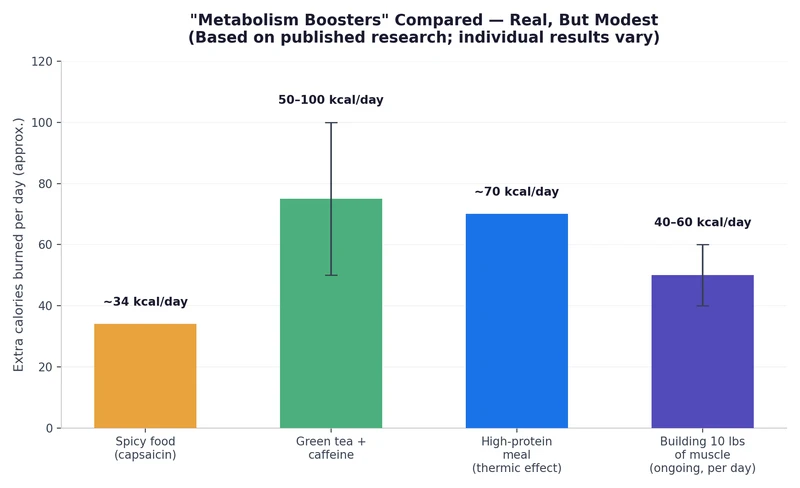
The honest summary: thermogenic foods and drinks work, in the sense that the physiological effect is measurable and reproducible in controlled studies. They just don’t work at the scale marketing around them implies. None of them substitute for the two factors — muscle mass and total activity — that actually move BMR and TDEE by hundreds of calories rather than dozens.
Sleep and NEAT: The Overlooked Levers
Two factors get far less search attention than food and supplements, despite mattering more in practice. Poor sleep is associated with disrupted hunger-regulating hormones and reduced insulin sensitivity, both of which affect how efficiently the body manages energy — though sleep’s direct effect on BMR itself is smaller and less consistent than its effect on appetite and food choices the next day.
NEAT — Non-Exercise Activity Thermogenesis — is the calorie burn from everyday movement that isn’t formal exercise: fidgeting, standing, taking the stairs, pacing during a phone call. Because NEAT sits outside BMR by definition, it’s technically part of TDEE rather than BMR itself, but it’s frequently the largest source of day-to-day variation in how many calories someone actually burns — often larger than the muscle-mass or thermogenic-food effects described above.
The Big Misconception: Eating At or Below Your BMR
This is, by a wide margin, the most-asked BMR question of all: “Should I eat my BMR to lose weight faster?” and its many variants — “my BMR is 1,400, how many calories should I eat?”, “is 1,500 enough if my BMR is that low?” — appear constantly in real search data, far outweighing any other BMR-related question cluster.
Why BMR Isn’t a Calorie Target
The short answer: BMR is not something to eat at, let alone below. It’s the floor your body needs just to run its basic functions while doing absolutely nothing else — no walking, no digesting food, no getting out of bed. Eating at or under your BMR number isn’t a faster route to weight loss; it means eating less than your body needs just to exist at rest, before a single calorie has gone toward actually living your day.
The chart below illustrates the gap using a hypothetical BMR of 1,400 kcal/day — the exact figure that shows up constantly across the keyword data behind this article. It’s an illustration, not a personal recommendation, but it shows how far ‘eating your BMR’ sits from a sustainable deficit built off total daily energy expenditure instead.
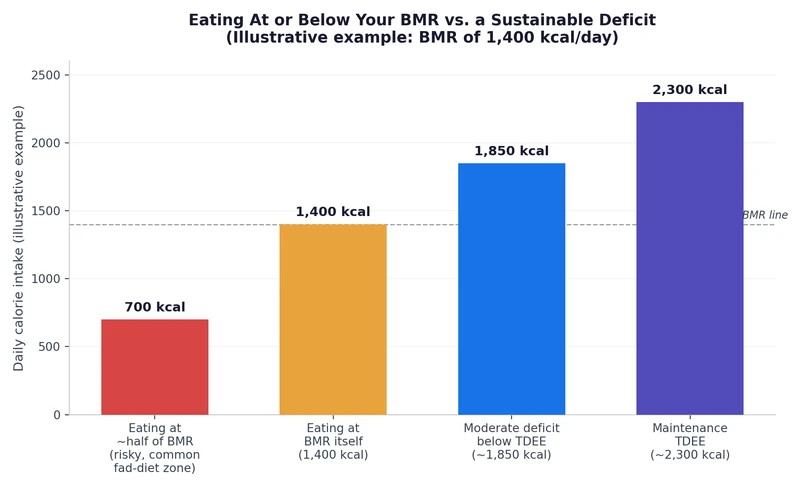
Illustrative example only — not a personalized recommendation. Actual targets depend on TDEE, activity level, and individual health factors.
What Happens Physiologically When You Undereat Long-Term
The research on what actually happens when people eat far below their needs is well documented, and it doesn’t support the idea that this speeds anything up. The most closely studied real-world example is “The Biggest Loser” competition, tracked for years afterward by NIH metabolism researcher Kevin Hall and colleagues. Contestants who lost extreme amounts of weight through severe restriction and extreme exercise volumes showed a measurable, lasting drop in resting metabolic rate — a phenomenon researchers call metabolic adaptation.
But Hall’s later reanalysis pushed back on the popular “they destroyed their metabolism” narrative that followed the show. In his 2018 review, he found the degree of metabolic slowdown wasn’t what predicted who regained weight afterward — some contestants with the most metabolic adaptation actually kept the most weight off six years later. His interpretation: the body genuinely compensates for extreme restriction and extreme activity, but that compensation is a normal, temporary energy-balancing response rather than permanent damage.
The practical takeaway for anyone Googling their specific BMR number: consistently eating below it isn’t a shortcut, and it isn’t the irreversible metabolic catastrophe viral ‘starvation mode’ content sometimes implies either — but it’s also not necessary or advisable for weight loss. A deficit built from your total daily needs (BMR × activity level, i.e. your TDEE) gets you to the same destination without leaving you undereating relative to what your body needs just to function.
What Counts as a Normal BMR — And How It Changes Across Life
“What is a good BMR” and “what is a normal BMR” both carry real, consistent search volume — and the honest answer is that there isn’t a single number, because BMR scales with body size, sex, age, and muscle mass rather than following one universal target. What’s more useful than chasing a fixed number is understanding how BMR predictably shifts across different life stages.
What is BMR by Age and Sex
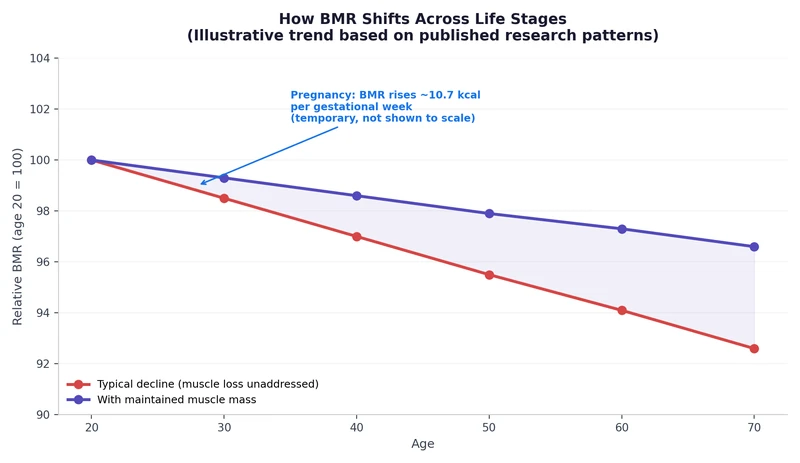
Resting metabolism declines by roughly 1–2% per decade starting around age 20, and that decline tracks closely with age-related loss of muscle mass rather than age itself. Someone who actively maintains muscle mass through their 40s, 50s, and 60s tends to see a meaningfully smaller BMR decline than someone who doesn’t — which is more actionable information than any single ‘normal’ number could be. Men typically show somewhat higher absolute BMR than women at the same height and weight, largely because men carry, on average, more lean muscle mass relative to total body size.
What is BMR During Pregnancy
This is a genuine gap in most BMR content, despite being a completely predictable, well-studied physiological shift. Basal metabolic rate rises steadily throughout pregnancy, increasing by an average of roughly 10.7 kcal per gestational week according to research published in the American Journal of Clinical Nutrition, driven by increased tissue synthesis, a larger active tissue mass, and greater cardiovascular and respiratory workload. This is part of why standard nutrition guidance recommends roughly 300 additional daily calories during pregnancy — it’s largely accounting for this steady BMR increase, not simply ‘eating for two.’
The magnitude of this increase varies considerably between individual women, which researchers have linked partly to pre-pregnancy body fat levels and the amount of gestational weight gained — another reminder that BMR, even in a well-studied and predictable scenario like pregnancy, still varies meaningfully from person to person.
BMR in Older Adults
The decline in BMR with age isn’t really an aging effect in isolation — it’s substantially a muscle-loss effect that happens to correlate with age. Adults who lose significant muscle mass (a process called sarcopenia) see a proportionally larger BMR decline than adults of the same age who maintain strength through resistance training, which is part of why maintaining muscle mass is now commonly recommended by researchers as a metabolic health strategy specifically for older adults, not just a fitness goal.
Why Individual BMR Varies So Much: Genetics and Medical Conditions
How Much of BMR Is Actually Genetic
This is a question BMR content almost never addresses directly, despite genuine research behind it. A classic study examining resting metabolic rate across parent-child pairs, fraternal twins, and identical twins found that genetics accounted for approximately 40% of the variance in RMR remaining after adjusting for age, sex, and fat-free mass. Broader estimates across twin and family studies put the total genetic contribution to basal metabolic rate somewhere in a wide 30–60% range — meaningful, but leaving plenty of room for lifestyle factors like muscle mass, activity, and diet to influence the rest.
The practical implication: if your BMR seems persistently lower or higher than a friend’s despite similar height, weight, and habits, genetics is a genuine, research-supported part of that difference — not something you’re imagining or doing wrong.
Medical Conditions — Thyroid Function
This connects directly back to the original 1919 research purpose. Thyroid hormone regulates metabolic rate directly, and hypothyroidism — an underactive thyroid — measurably lowers it. A 2025 clinical study comparing 100 hypothyroid patients against 100 matched controls found significantly lower BMR in the hypothyroid group — roughly 1,196 vs. 1,363 kcal/day on average — alongside lower core body temperature, both consistent with thyroid hormone’s central role in regulating metabolism.
If a calculated BMR feels persistently, unexplainably low relative to body composition and activity level — not just lower than hoped for, but genuinely inconsistent with size and muscle mass — a thyroid function check with a doctor is a reasonable next step, not just a stricter diet.
Why BMR Calculators Disagree With Each Other
Plug the same height, weight, and age into two different BMR calculators and the results often won’t match — not because one is broken, but because they’re built on different formulas, developed from different research populations, decades apart.
The chart below shows this directly, running one hypothetical person’s stats — a 35-year-old man, 80kg, 178cm, 18% body fat — through four of the most common formulas.
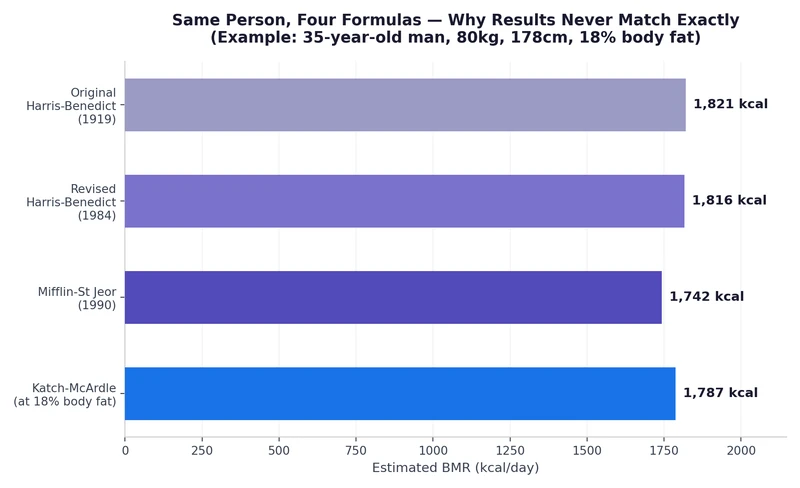
The gap between formulas here is modest — under 5% — but it’s worth knowing why it exists. The original 1919 Harris-Benedict equation was built from a relatively small, homogeneous research sample and tends to run slightly higher than modern formulas. The 1984 revision corrected some of that using a larger dataset. Mifflin-St Jeor (1990), built from a much larger and more contemporary population, is generally treated as the most broadly accurate for typical adults today. Harris-Benedict’s own published confidence range is roughly ±213 kcal/day for men and ±201 kcal/day for women — a useful reminder that every formula here is an estimate, not a lab measurement.
Katch-McArdle behaves differently because it factors in body composition directly rather than estimating purely from height and weight — which is why it tends to be more accurate for people who know their actual body fat percentage, particularly athletes or anyone with unusually high or low muscle mass relative to their size.
Fast Reference Cheat Sheet
- BMR = calories burned at complete rest; typically ~60–75% of total daily calorie burn
- RMR runs about 10% higher than BMR due to looser measurement conditions — same idea, different test strictness
- Resting metabolism declines ~1–2% per decade after age 20, mostly tracking muscle loss rather than age itself
- Genetics accounts for roughly 30–60% of individual BMR variation, per twin and family studies
- Muscle burns ~3× more at rest than fat, pound for pound — real, but modest per pound (about 40–60 extra kcal/day for 10 lbs of muscle)
- Spicy food raises RMR by ~34 kcal/day on average (meta-analysis of 13 RCTs) — real, but less than half of protein’s thermic effect
- BMR rises by ~10.7 kcal per gestational week during pregnancy, which is largely why ~300 extra daily calories are recommended
- Different formulas can disagree by 3–5% for the same person — that’s expected, not an error
- Consistently eating at or below BMR isn’t a faster route to weight loss — deficits should come from TDEE, your full daily need, not your resting floor
The Bottom Line
This must have answered and cleared almost everything about what is BMR. It is clear by now that BMR is a genuinely useful number — it’s the foundation every calorie target, from maintenance to a weight-loss deficit, is built on. Where people run into trouble isn’t the number itself, it’s treating it as a target to hit or undercut rather than a floor to build above. Combine it with your activity level to get your real daily need (TDEE), account for the things that actually shift it — muscle mass, age, genetics, thyroid health, pregnancy — and it becomes a genuinely practical planning tool instead of a confusing figure to chase or fear.
Calculate Your BMR
Ready to see your own number? Use our free BMR Calculator — it supports three formulas (Mifflin-St Jeor, Revised Harris-Benedict, and Katch-McArdle) and shows your daily calorie needs across every activity level instantly.
Frequently Asked Questions
Should I eat at or below my BMR to lose weight?
No. Your BMR is the minimum energy your body needs at complete rest — before accounting for any movement, exercise, or daily activity. Eating at or below that number isn’t a faster route to weight loss; it means eating less than your body needs just to run its basic functions. A sustainable deficit should be based on your TDEE (BMR × activity level), not your BMR alone
How many calories should I eat if my BMR is 1,400–1,600?
There’s no single safe number that applies to everyone at this BMR range — it depends on your activity level, TDEE, and goals. As a general principle, sustainable weight loss guidance involves a moderate deficit below TDEE (your full daily energy need), not eating down toward your BMR itself. If you’re planning a specific calorie target, it’s worth discussing your numbers with a doctor or registered dietitian rather than working from BMR in isolation.
What is BMR vs RMR?
BMR is measured under strict lab conditions — right after waking, fully fasted, completely at rest. RMR uses more realistic, less restrictive conditions, which is why nearly every real-world metabolism test is technically measuring RMR. RMR typically runs about 10% higher than BMR. For everyday calorie planning, the two are close enough to use interchangeably.
Can spicy food, coffee, or green tea actually boost my BMR?
To a small, measurable degree, yes — but not enough to meaningfully affect weight on their own. A meta-analysis of 13 clinical trials found spicy food’s capsaicin raises resting metabolic rate by about 34 kcal per day on average, less than half of what a high-protein meal does. Green tea combined with caffeine shows similarly modest effects in research, typically in the range of 50–100 kcal per day. Both are real effects, just smaller than marketing around them suggests.
What’s a normal or good BMR?
There isn’t one universal number — BMR scales with body size, sex, age, and especially muscle mass. What’s better established is the trend: resting metabolism tends to decline roughly 1–2% per decade starting around age 20, largely tracking muscle loss rather than age itself. Comparing your BMR over time to your own baseline is more useful than comparing it to a population average.
Does BMR change during pregnancy?
Yes, predictably so. Research shows BMR rises by roughly 10.7 kcal per gestational week on average, driven by increased tissue synthesis and cardiovascular workload. This is a major reason standard nutrition guidance recommends around 300 additional daily calories during pregnancy — it largely reflects this steady BMR increase rather than a general ‘eating for two’ idea.
What does a low BMR mean, and can I raise it?
A lower-than-expected BMR can reflect lower muscle mass, older age, genetics, or in some cases an underlying medical condition like hypothyroidism. Building and maintaining muscle mass is the most well-supported way to influence BMR over time, though the effect per pound of muscle is real but modest. A persistently low BMR that doesn’t match your body composition is worth discussing with a doctor.
Can a health condition like hypothyroidism affect my BMR?
Yes. Thyroid hormone directly regulates metabolic rate, and hypothyroidism (an underactive thyroid) is well documented to lower BMR, sometimes significantly — clinical studies have found meaningful differences between hypothyroid patients and matched healthy controls. If your calculated BMR feels persistently inconsistent with your size and activity level, a thyroid function check is a reasonable step; this isn’t something a calculator can diagnose.
Why do BMR calculators give different results?
Different calculators use different formulas — Harris-Benedict (1919, revised 1984), Mifflin-St Jeor (1990), and Katch-McArdle (1973) were each built from different research populations, decades apart. Results commonly vary by 3–5% between formulas for the same person, which is expected, not an error. Mifflin-St Jeor is generally considered the most broadly accurate for typical adults; Katch-McArdle tends to be more precise if you know your actual body fat percentage.
What is BMR?
BMR is the minimum number of calories your body needs to perform essential functions such as breathing, circulation, and cell repair while at complete rest.
What is BMR used for?
BMR helps estimate your daily calorie needs and serves as the foundation for calculating Total Daily Energy Expenditure (TDEE).
Related tools: BMR Calculator, Calorie Calculator, Macro Calculator