
What Is EMI? The Surprising Truth Behind How It’s Calculated

What is EMI? It’s the acronym for Equated Monthly Installment — the fixed payment you make on almost every loan or big purchase in India. It’s on your home loan statement, your car loan agreement, and that “Pay in Easy EMI” button at checkout. But most people who use the word every month couldn’t actually explain what’s happening behind it.
Here’s a simple example of where that gap shows up. Say you buy a phone for ₹30,000 and the store offers “Easy EMI: ₹2,500/month for 12 months.” You do the maths in your head — ₹2,500 × 12 = ₹30,000 — and think, great, no extra cost. Except most of the time, that’s not quite what’s happening. There’s usually interest tucked into that number somewhere, even when nobody says the word “interest” out loud.
That gap between what EMI sounds like and what it actually costs is where most of the confusion around this word comes from. So let’s clear it up properly — what EMI actually stands for, how lenders quietly calculate it two very different ways, and what genuinely happens if you miss a payment one month.
One quick note before we start: if you’ve landed here from a Google search, you may have noticed “EMI” means different things depending on context — it can refer to electromagnetic interference in electronics, or even a dementia care ward in the UK’s NHS system. None of that is what this article covers. We’re talking about Equated Monthly Installment — the loan repayment term you’ll run into on every home loan, car loan, or “Buy Now, Pay Later” checkout button in India.
What Is EMI? The Basic Definition
EMI stands for Equated Monthly Installment. It’s the fixed amount you pay your lender every month until a loan is fully cleared. Each payment is really two payments stitched into one: a slice that goes toward paying back what you borrowed (the principal), and a slice that goes toward what the lender charges you for lending it (the interest).
Think of it like a subscription, except instead of paying for Netflix every month, you’re slowly buying back a loan you already spent. The Consumer Financial Protection Bureau in the US describes this exact structure — fixed payments where more goes to interest early on and more goes to principal later — as an “amortizing loan.” India just calls it EMI, and the term has become so common that most people use it without ever unpacking what it actually means.
If you’ve taken a home loan, a car loan, a personal loan, or even bought a laptop on “No Cost EMI” — you’ve used this exact mechanism. Same math, different price tag.
Wait — Is EMI a Loan, or Part of One?
Good question, and a common one. EMI is not the loan itself — it’s how you pay it back. The loan is the ₹30,000 you borrowed. The EMI is the ₹2,500 monthly payment you agreed to make in order to return it, plus interest, over time.
Quick Detour: Where Did “EMI” Even Come From?
This isn’t a purely Indian invention, even though the acronym is used almost exclusively here. The idea of equal periodic loan repayments actually goes back to 19th-century amortization practices, but it only became a mainstream consumer finance tool in the mid-20th century — with the State Bank of India credited with introducing EMI-style repayment schemes in the 1950s, specifically to make repaying loans less confusing for ordinary people.
The real turning point for India, though, came a couple of decades later. HDFC, founded in 1977, pioneered long-term home loans built around equated monthly payments — right as India’s urban middle class was growing and owning a home was starting to feel achievable for salaried families, not just the wealthy. That’s roughly the moment “EMI” went from a bank’s internal accounting term to a word every Indian household knows.
Curiously, the exact same idea was taking off in America around the same era — just under a completely different name. Wartime credit restrictions in the US limited installment lending, but once those rules were lifted in 1947, consumer credit nearly doubled by the mid-1950s as families financed cars and refrigerators through fixed monthly payments. Same concept. Different acronym. Different decade of going mainstream.
Speaking of which — a common search alongside “what is EMI” is:
“What is EMI called in America?”
Trick question, kind of — Americans don’t use the term EMI at all. In US banking, the same thing is simply called a “monthly payment” or a “loan payment.” The math underneath (splitting a fixed payment between interest and principal) is identical. India just gave it a catchier name.
The Formula, for the Curious
Now that you know what is EMI in plain terms, here’s what’s actually going on under the hood:
EMI = P × r × (1 + r)ⁿ ÷ [(1 + r)ⁿ − 1]
- P = the amount you borrowed (principal)
- r = the monthly interest rate (your annual rate ÷ 12)
- n = total number of monthly payments (your loan tenure in months)
You don’t need to memorize this. What’s actually useful is knowing what moves the needle: borrow more, EMI goes up. Stretch the tenure, EMI drops but you pay more total interest. Get a lower rate, EMI drops too — but not always in the way you’d expect, which brings us to the part that trips up almost everyone.
The Real Trap: Two Loans Can Say “10% Interest” and Cost Totally Different Amounts
Here’s the thing nobody tells you upfront, and it’s probably the single most-searched confusion around EMI: why is my EMI way higher than I expected, even though the interest rate looked completely normal?
The answer, almost every time, comes down to which of two methods your lender used to calculate that “10%.”
Method 1 — Reducing balance (the fairer, more common one): interest is charged only on what you still owe. Every time you pay an EMI, your outstanding balance shrinks a little — so next month’s interest is calculated on a smaller number. This is the industry standard for most lenders, and it’s the default method for home loans, personal loans, and most car loans.
Method 2 — Flat rate: interest is calculated once, on the entire original loan amount, and that same interest keeps getting charged for the whole tenure — even in month 47 of a 48-month loan, when you’ve almost paid the whole thing off. Your balance is shrinking, but the interest math doesn’t care — it keeps charging you as if you still owed the full original amount. This method shows up a lot on two-wheeler loans and some consumer-durable EMIs, mostly because it’s simpler to explain at the point of sale.
The gap between the two isn’t small — it’s often close to double. A loan advertised at a 12% flat rate works out to roughly a 21% effective rate once you convert it to reducing-balance terms — nearly twice the number on the poster.
Let’s make this real with actual numbers. Say two people each borrow ₹5,00,000 for 5 years, and both are told “10% interest.”
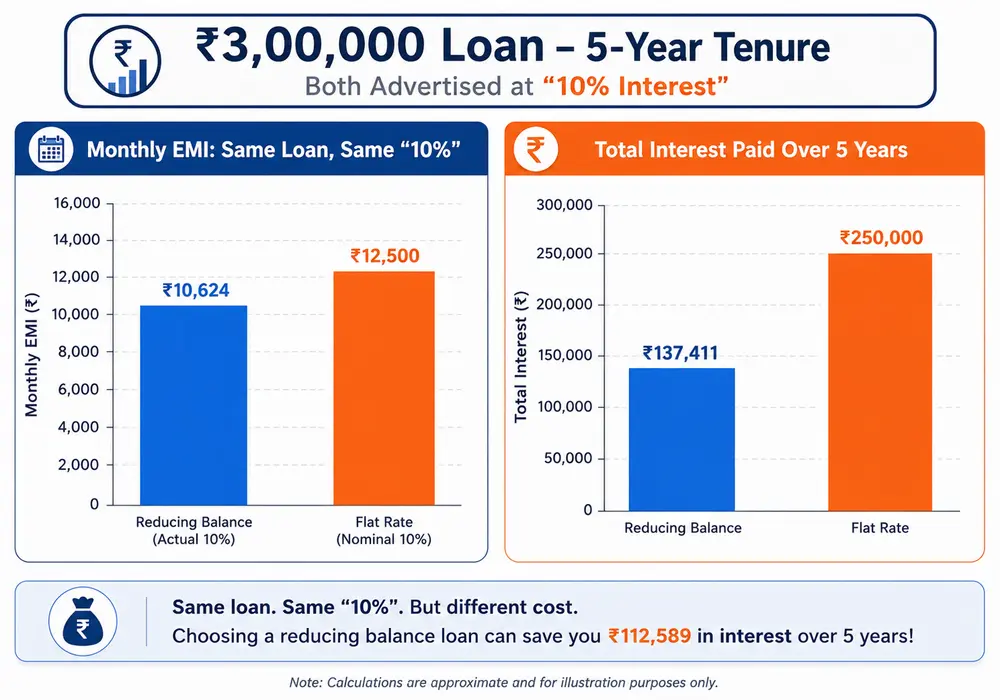
Same loan amount. Same tenure. Same headline rate. And yet the flat-rate borrower pays about ₹1,875 more every single month, and roughly ₹1,12,600 more in total interest over the life of the loan — for a loan that was advertised at the identical “10%.” Nobody lied on the poster. The method was just never mentioned.
The one question that saves you this trap: before signing anything, ask your lender directly — “Is this a flat rate or a reducing balance rate?” If they hesitate, that’s usually your answer.
Okay, So Why Does My Fixed EMI Pay Off Different Amounts Each Year?
This one confuses people too, and it’s actually the flip side of the same coin. On a reducing-balance loan, your EMI amount is identical every single month — but what that fixed number is made of keeps shifting behind the scenes.
Picture a jug that’s mostly filled with “interest” water in year one, and by year five, it’s almost entirely “principal” water — even though you’re pouring out the exact same amount every month.
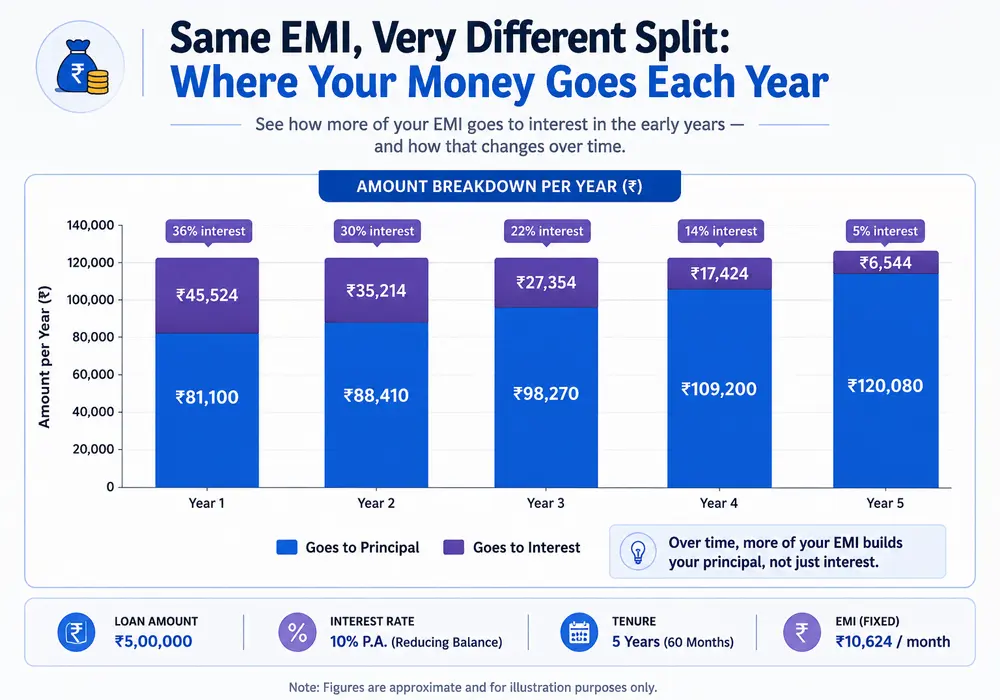
On that same ₹5,00,000 loan, about 36% of what you pay in Year 1 is pure interest — but by Year 5, that drops to just 5%. Same EMI amount on your bank statement every month. Wildly different job that money is doing behind the scenes.
Why this matters practically: if you ever come into extra cash and want to prepay part of your loan, doing it early saves you far more interest than doing it late — because you’re cutting into the balance while the expensive, interest-heavy years are still ahead of you. Paying an extra ₹20,000 in Year 1 saves more than paying the same ₹20,000 in Year 4.
Not All EMIs Behave the Same Way
Once you know what is EMI at its core, it helps to know it doesn’t always work the same way. Beyond the flat-vs-reducing split, there are a couple of other flavours worth knowing:
- Fixed EMI — the payment never changes for the entire loan, regardless of what’s happening with interest rates elsewhere. Most personal loans and fixed-rate home loans work this way.
- Step-up EMI — starts smaller and grows over time. Useful if you’re early in your career and expect your income to rise.
- Step-down EMI — starts bigger and shrinks over time. Useful for borrowers closer to retirement who expect income to fall.
- Floating-rate EMI — can move up or down whenever the lender’s benchmark interest rate changes, common on home loans.
On the floating-rate front, there’s some genuinely good recent news for borrowers: RBI now requires lenders to hand over a standardised fact sheet showing the full cost of the loan upfront — the actual Annual Percentage Rate, including interest, processing fees, and penalty charges — so nothing sneaky shows up after approval. Borrowers on floating-rate loans can also now switch to a fixed rate at set reset points, instead of being stuck with whatever they originally picked.
What Is an “EMI Card”? (It’s Not a Credit Card)
Once you understand what is EMI at a basic level, the next confusing thing you’ll run into is the “EMI Card. If you shop at Croma or Reliance Digital, or check out on Flipkart or Amazon, you’ve probably been offered an “EMI Card” — most commonly the Bajaj Finserv Insta EMI Card, also called the EMI Network Card. It’s worth a section of its own because a lot of people assume it’s just another credit card. It isn’t, quite.
An EMI Card is really a customer identification number that gives you access to a pre-approved loan from the issuing NBFC (non-banking financial company) — every purchase you make on it is treated as a separate loan, not as revolving credit. In Bajaj Finance’s case, it comes with a pre-qualified loan offer of up to ₹3,00,000, usable across 1.5 lakh+ partner stores in 4,000+ cities, both online and offline. You can shop with it at major retailers like Croma, Reliance Digital, and Vijay Sales, and online through partners like Amazon, Flipkart, and MakeMyTrip.
A few things that make it genuinely different from a normal credit card:
- Unlike a credit card, it can’t be used for cash withdrawals — it’s built purely for converting purchases into EMIs.
- Getting one typically involves a small one-time joining fee (around ₹530 for Bajaj’s card) rather than the annual fees credit cards often carry.
- Interest rates on EMI cards run from 0% (on no-cost EMI deals) up to around 13–18% per annum otherwise — and importantly, this is a product specific to the issuing NBFC; traditional banks don’t co-brand this exact instrument, though they offer their own “EMI on credit card” conversions with rates that tend to run lower, around 11–15% per annum.
Bottom line: an EMI card is a handy way to convert one-off big purchases into predictable monthly payments without applying for a fresh loan each time — but it’s still debt, still shows up on your credit report, and the golden rule from earlier still applies: check whether the scheme is genuinely 0% or a flat/reducing rate in disguise before you swipe.
“No Cost EMI” — the Phrase That’s Doing a Lot of Marketing Work
You’ve seen this at checkout for phones, appliances, even flight tickets: “No Cost EMI.” Sounds like a free lunch. It mostly isn’t, and the RBI has actually stepped in on this one directly.
Back in September 2013, the RBI banned banks from offering genuinely 0% interest EMI schemes on consumer purchases, because the “hidden” interest was usually just getting passed on to the customer disguised as a processing fee instead — technically zero interest, practically not free.
Here’s the honest version of how “no cost” EMI usually works: the bank still charges real interest behind the scenes — often 14% to 20% — but that cost gets absorbed upfront by the retailer as a “discount” that you never actually see. So if a phone costs ₹74,900, and you take the no-cost EMI option instead of paying in full, you likely just gave up a discount you would’ve gotten by paying upfront — in exchange for spreading the same ₹74,900 across a few months.
It’s not a scam, exactly. It’s a genuinely useful cash-flow tool for big purchases. Just don’t expect it to be a literal zero-cost loan, because someone, somewhere, is still paying the interest — it’s just not labelled as “interest” on your receipt.
EMI on a Car Loan: What Makes It Different
The core answer to what is EMI stays the same for a car loan, but a few things work differently.
- Down payment moves the needle a lot. Lenders typically finance up to 90% of a car’s on-road price, so the bigger your upfront down payment, the smaller your principal — and the smaller your EMI. A higher down payment directly reduces both your monthly EMI and your total interest cost.
- Tenure is shorter than home loans. Most car loans run 1 to 5 years, though some lenders extend up to 7 years for the right borrower. Same trade-off as always: longer tenure means smaller EMI but more total interest.
- Rates depend on more than just the bank’s mood. Your interest rate is shaped by your credit score, income stability, and eligibility profile — typical new-car loan rates in India run roughly 8.75% to 11.5% per annum, though this moves with RBI repo rate changes.
- Used cars are trickier. Lenders are often reluctant to finance older used cars because of how much value they’ve already lost — a car’s age is usually the biggest factor in used-car loan eligibility, more than the buyer’s own profile.
- Prepayment isn’t always free on car loans. Unlike the newer floating-rate personal loan rules, many car loan prepayments still carry charges — HDFC, for instance, charges roughly 5% on the prepaid amount if done within 13–24 months of the first EMI, dropping to about 3% after 24 months. Always check this before assuming an early payoff is free.
Why Do We Even Pay EMI? (The Benefits, Briefly)
Why Do We Even Pay EMI? (Understanding What Is EMI’s Real Purpose). A few genuine upsides:
- You get the thing now, not in three years. A house, a car, or an education often can’t wait for you to save the full amount — EMI lets you use the asset while you’re still paying for it.
- Predictable budgeting. A fixed EMI is easier to plan around than an unpredictable lump sum you’d otherwise need to set aside.
- It can build your credit history. Paying EMIs on time, consistently, is one of the more reliable ways to build a strong credit score over time — assuming you don’t fall into the missed-payment trap covered below.
- It spreads risk on big-ticket purchases. Rather than draining your entire savings on one purchase, EMI keeps a chunk of your liquidity free for emergencies.
The trade-off, obviously, is interest — you’re paying for the convenience of “now” instead of “later.” Whether that trade-off is worth it depends entirely on the loan terms and your own repayment capacity, which is exactly what the rest of this article is about.
Common EMI Mistakes to Avoid
Knowing what is EMI and how it’s calculated is only half the battle — a lot of EMI regret comes from a handful of avoidable mistakes.:
- Not asking flat vs. reducing balance. Already covered above, but worth repeating: this single question can change your real cost by close to 2x.
- Letting EMI eat too much of your income. A commonly used rule of thumb is to keep your total EMI outgo under 40% of your monthly income — go much higher, and one unexpected expense can put you in a genuinely difficult spot.
- Ignoring the extra fees. Processing fees, late payment charges, and prepayment penalties often get left out of a borrower’s mental math — only the principal and interest get considered. Ask for the full fee schedule upfront.
- Not checking prepayment terms before you need them. Some lenders charge a real penalty for paying off a loan early, which can undercut the interest savings you were counting on. Know this before you commit, not after.
- Trusting the calculator blindly. An EMI calculator gives you a solid estimate, but it can’t account for future rate changes on a floating loan, hidden charges, or a sudden change in your own finances — treat it as a planning tool, not a guarantee.
- Borrowing based on what you’re offered, not what you need. Lenders often pre-approve amounts higher than what’s actually sensible for your situation. A bigger sanctioned loan isn’t a signal that you should use all of it.
The Question Everyone’s Actually Worried About: “What Happens If I Miss an EMI?”
Life happens — salary gets delayed, an auto-debit fails, you forget a due date. Here’s what genuinely occurs, step by step, and the honest news is that it’s gotten a little more forgiving recently.
Step 1 — The classification. The moment a payment is late, lenders track it using RBI’s “Special Mention Account” system. Being 1–30 days late puts your account in category SMA-0. 31–60 days late moves it to SMA-1. These aren’t scary yet — they’re early warning flags.
Step 2 — The grace window. This is the part that’s genuinely improved: RBI now requires lenders to send you an official 30-day notice after a missed EMI before they’re allowed to report it to credit bureaus. If you clear the dues within those 30 days, nothing gets reported to CIBIL at all. This didn’t always exist — it used to be much less forgiving.
Step 3 — If it’s still unpaid. If the 30 days pass and it’s still outstanding, expect a real hit — a single missed EMI can drop your CIBIL score by 50 to 70 points, and some sources put it as high as 100 points, depending on your credit history. That mark can stay visible on your credit report for up to 7 years, though its actual impact on your score fades the longer you stay clean afterward.
Step 4 — The line you really don’t want to cross. Miss payments for more than 90 days straight, and the account gets classified as a Non-Performing Asset (NPA) — a much more serious mark that’s genuinely hard to recover from. The gap between a 10-day delay and a 90-day one isn’t a matter of degree. It’s the difference between a temporary dent and a years-long problem.
One more recent change worth knowing: since January 1, 2025, lenders have been required to update your credit report every 15 days instead of once a month (under RBI Circular DoR.FIN.REC.No.32/2024-25). Good news if you’ve cleared a missed payment — the fix shows up in your score faster too, not just the damage.
What About Paying Off a Loan Early?
If you’re the type who wants to be debt-free faster, there’s good news here too: floating-rate personal loans in India can no longer carry prepayment penalties — so you can pay extra whenever you have spare cash, without getting charged for it.
And remember the amortization chart from earlier? That’s exactly why when you prepay matters. Extra money thrown at your loan in Year 1 saves more total interest than the same amount thrown at it in Year 4 — because that’s when the interest-heavy portion of your EMI is still doing the most damage.
What Is EMI? The Fast-Reference Cheat Sheet
- EMI = Equated Monthly Installment — a fixed monthly payment that covers both principal and interest
- Reducing balance = interest shrinks as your balance does; standard for home, personal, and most car loans
- Flat rate = interest stays fixed on the original amount all tenure long; common on two-wheeler and some consumer-durable loans; can cost nearly double the advertised rate
- “No-cost EMI” = still real interest, just paid by the retailer upfront instead of by you monthly
- One missed EMI = a possible 50–100 point CIBIL drop, but a 30-day grace window (per current RBI rules) gives you a real chance to fix it first
- 90+ days overdue = classified as NPA, a serious mark that’s genuinely hard to undo
A Simple Way to Think About It
Whenever the details start to feel like a lot, come back to this: what is EMI, really, if not just a way of saying “I’ll pay this loan back in equal chunks, every month, until it’s done.” The concept is simple. The part worth your attention is how the lender is calculating the interest hidden inside that chunk — because that’s where identical-looking loans quietly become very different deals.
Try It Yourself
Curious what your own loan would actually cost? Our free Loan EMI Calculator does the math instantly — just enter your loan amount, interest rate, and tenure to see your exact monthly payment and full repayment breakdown.
Frequently Asked Questions
What is EMI? What does it stand for?
‘EMI’ stands for ‘Equated Monthly Installment’ — a fixed monthly payment covering both principal and interest, made until a loan is fully repaid.
Is EMI a loan, or something separate from a loan?
EMI isn’t the loan itself — it’s how you repay one. The loan is the money you borrowed; the EMI is the fixed monthly amount you agreed to pay back over time.
What is EMI called in America?
There’s no separate term — Americans simply call it a “monthly payment” or “loan payment.” The underlying math is identical to what EMI describes in India.
Is EMI good or bad?
Neither, on its own — to really answer what is EMI’s impact, it depends entirely upon repayment structure. It works in your favour when the loan amount, interest rate, and tenure comfortably fit your monthly budget — and works against you when the EMI stretches your finances too thin, or when the interest method (flat vs. reducing) is quietly more expensive than it needed to be.
What happens if I miss an EMI payment?
Your account gets flagged under RBI’s Special Mention Account system starting from day one past due. Under current rules, you get a 30-day notice window to clear it before anything is reported to credit bureaus. Miss that window, and expect a CIBIL score drop of roughly 50–100 points, plus possible late fees. Cross 90 days overdue, and the loan risks being classified as a Non-Performing Asset — a much more serious, longer-lasting mark.
What’s the difference between flat rate and reducing balance EMI?
Flat rate charges interest on the full original loan amount for the entire tenure, no matter how much you’ve already repaid — which makes it more expensive overall. Reducing balance charges interest only on what’s still outstanding, so the interest portion shrinks as you repay. Reducing balance is the standard, generally cheaper method for most home, personal, and car loans.
Is “no-cost EMI” actually interest-free?
Not quite. The lender still charges real interest — it’s just absorbed upfront by the retailer as a forgone discount instead of being billed to you directly. Your total payment can end up matching the sticker price, but you usually give up an upfront discount you’d have gotten by paying in full.
What is an EMI Card, and is it the same as a credit card?
An EMI Card (like the Bajaj Finserv Insta EMI Card) is a pre-approved loan facility used specifically to convert purchases into EMIs at partner stores — it’s not a credit card. It can’t be used for cash withdrawals, generally involves a small one-time joining fee instead of an annual fee, and every purchase is treated as its own separate loan rather than revolving credit.
Is it better to pay in EMI or pay the full amount upfront?
It depends on your cash flow and the interest involved. Paying in full avoids interest entirely and is usually cheaper overall — but EMI makes sense when a lump-sum payment would drain your savings or when a genuinely 0% no-cost EMI deal is available. The trade-off is convenience and liquidity now, versus a lower total cost later.
Who is responsible for paying an EMI?
The person who took out the loan is solely responsible for the EMI, even if the purchase or property is jointly used. On a joint loan, all co-borrowers are typically held jointly and individually liable, meaning the lender can pursue any one of them for the full outstanding amount if payments stop.
Related tools: Loan EMI Calculator, Simple Interest Calculator, Retirement Calculator